

Business mortgage financing provides businesses with access to capital to purchase, consolidate, or expand commercial real estate. For entrepreneurs, small businesses, and property investors in Vaughan, Ontario, and across the Greater Toronto Area (GTA), it can support the acquisition of office buildings, industrial properties, retail spaces, and mixed-use developments.
With the right financing structure, businesses can improve cash flow, reduce financial risk, build long-term equity, and create opportunities for expansion. Whether buying a commercial property or refinancing an existing mortgage, business mortgage financing can play a key role in supporting stability and sustainable growth.
Understanding Business Mortgage Financing
Business mortgage financing involves loans secured against commercial or industrial property used for business purposes. Traditional residential mortgages are assessed primarily on business performance, property value, and projected cash flow rather than solely on personal income.
Mortgage finance for business is commonly used for:
- Purchasing commercial real estate
- Constructing or renovating business premises
- Refinancing existing commercial mortgages
- Releasing equity for expansion or working capital
For small business owners in Canada, a business mortgage can serve as a strategic asset rather than just a liability. Owning property can stabilize occupancy costs, protect against rental increases, and build long-term equity.
Business Mortgage Finance Versus Residential Mortgages
While both products involve property as collateral, business mortgage finance differs significantly from residential lending.
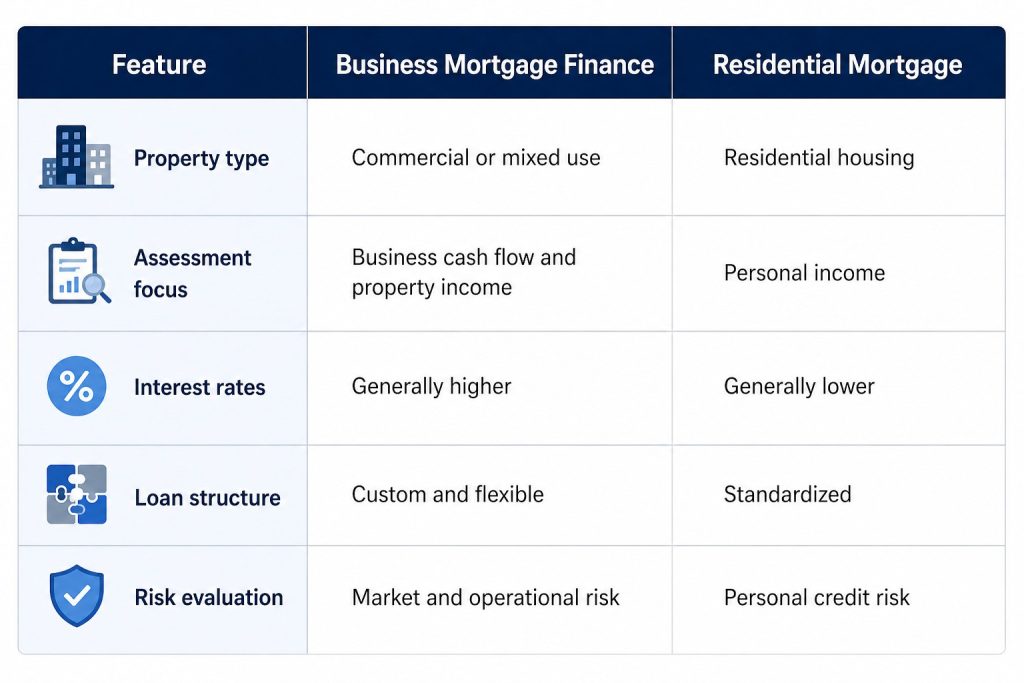
Understanding these differences helps business owners set realistic expectations when applying for mortgage finance business solutions.
Mortgage for Small Business Owners in Canada
A mortgage for small business owners in Canada is often tailored to reflect both personal and commercial financial profiles.
Lenders typically evaluate the following factors:
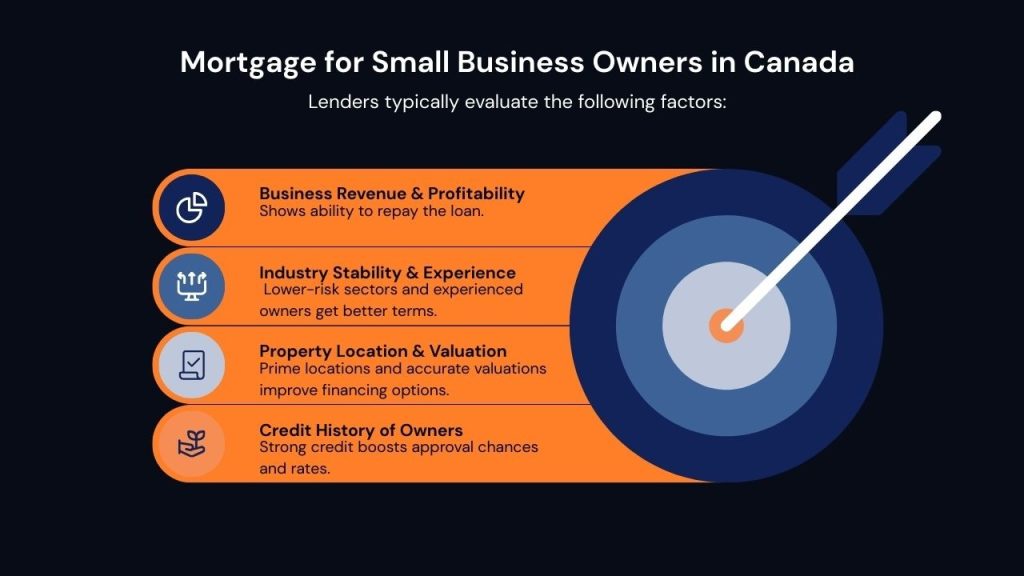
Small business owners may access business mortgage financing through banks, credit unions, or alternative lenders. While traditional institutions offer competitive rates, alternative lenders often provide faster approvals and more flexible terms.
Key Types of Business Mortgage Financing in Canada
Owner-Occupied Commercial Mortgages
Owner-occupied business mortgage finance is used when the business operates from the property it owns. These mortgages often come with more favorable terms because the property directly supports revenue generation.
Investment Commercial Mortgages
These mortgages are designed for businesses or individuals purchasing income-generating commercial property. Rental income becomes a key factor in assessing mortgage finance business applications.
Construction and Development Mortgages
Construction-focused business mortgage financing supports new builds or major renovations. Funds are typically released in stages based on project milestones.
Refinancing and Equity Release
Refinancing allows businesses to restructure existing debt, secure better rates, or unlock property equity. This approach supports adaptive business finance options by freeing capital for growth.
Adaptive Business Finance Options for Modern Enterprises

Adaptive business finance options are designed to align financing with real-world operational needs. In Canada, these options have become increasingly important as businesses face fluctuating markets and evolving economic conditions.
Examples of adaptive business finance options include:
- Adjustable and fixed-rate hybrid mortgages
- Flexible amortization periods
- Interest-only payment structures during growth phases
- Blended financing combining mortgage and working capital
These solutions help businesses manage cash flow while still investing in long-term assets.
Business Mortgage Financing Process in Canada
Understanding the process can significantly improve approval outcomes.
- Initial assessment of business financial health
- Property valuation and market analysis
- Selection of an appropriate mortgage finance business structure
- Submission of application and supporting documentation
- Credit and risk evaluation by the lender
- Approval, legal review, and funding
Each stage requires accurate financial reporting and professional guidance, particularly for small business owners navigating complex mortgage structures.
Cost Structure of Business Mortgage Finance
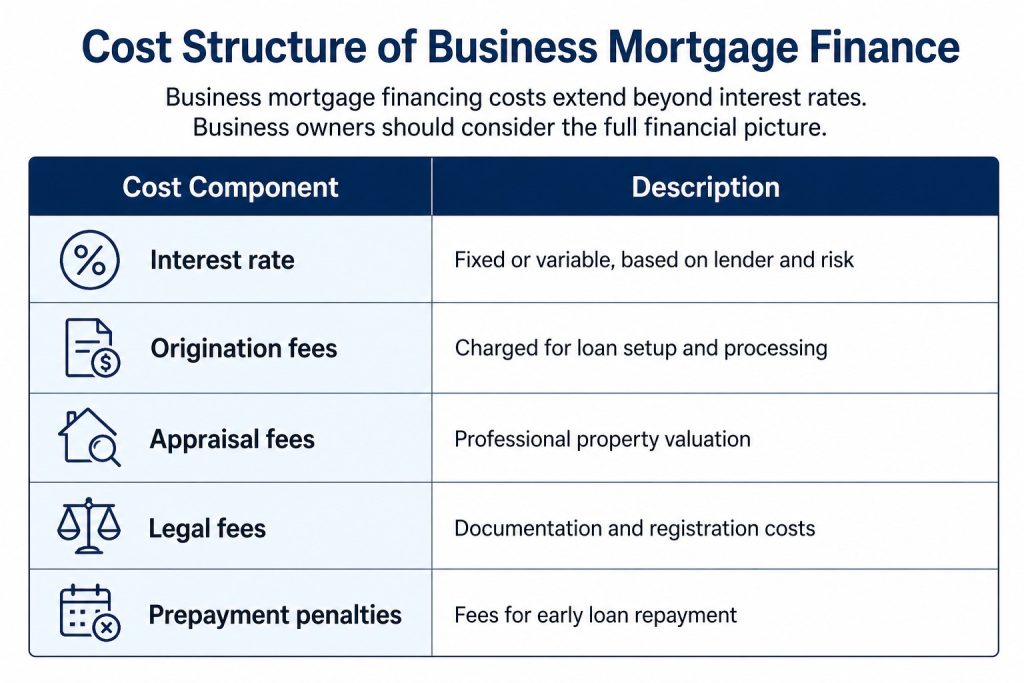
Evaluating these costs ensures mortgage finance business decisions remain sustainable.
Cash Flow Impact Analysis
The relationship between mortgage payments and business cash flow is critical. The following text-based graph illustrates a simplified comparison between renting and owning under a business mortgage.
Graph Description: Monthly Cost Comparison
Renting Model: Months 1 to 12 show a consistent upward trend due to annual rent increases
Owing to business mortgage finance, months 1 to 12 show a stable payment line with slight variation under variable rate options.
This comparison highlights how owning a business through mortgage financing can offer predictable long-term expenses.
Risk Management in Business Mortgage Financing
Every mortgage finance business strategy involves risk. Key risks include interest rate fluctuations, market value changes, and operational disruptions.
Risk mitigation strategies include:
- Choosing appropriate fixed or variable rate structures
- Maintaining cash reserves
- Securing insurance coverage
- Using adaptive business finance options during uncertain periods
- Professional advisory support can help align financing with risk tolerance.
Government and Institutional Support in Canada
Canada offers various programs that indirectly support mortgages for small business owners through lending incentives and risk-sharing initiatives. These programs encourage financial institutions to extend credit to growing enterprises while maintaining responsible lending practices.
Although eligibility criteria vary, businesses that demonstrate strong fundamentals and compliance often benefit from enhanced access to business mortgage financing.
Strategic Benefits of Business Mortgage Financing
When structured correctly, business mortgage finance offers several strategic advantages.
- Asset ownership and equity growth
- Improved balance sheet strength
- Protection against commercial rent volatility
- Enhanced long-term financial planning
For small business owners in Canada, these benefits often outweigh the initial complexity of mortgage finance business arrangements.
Choosing the Right Business Mortgage Finance Partner
Selecting the right lender or advisory partner is just as important as choosing the mortgage itself. Businesses should evaluate experience, transparency, flexibility, and long-term support.
A strong partner helps identify adaptive business finance options that align with growth goals rather than offering one-size-fits-all solutions.
Future Trends in Business Mortgage Financing
The Canadian business mortgage landscape continues to evolve. Digital underwriting, data-driven risk assessment, and customized financing models are shaping the future of mortgage finance business solutions. As competition increases, small business owners are likely to benefit from more tailored and accessible business mortgage financing products.
By approaching mortgage finance business decisions with informed planning and professional guidance, businesses can transform property ownership into a powerful driver of competitive advantage.
FAQ
1. What is business mortgage financing?
Business mortgage financing is a loan used to purchase, refinance, build, or renovate commercial property. It is secured by the property and designed to support long-term business growth.
2. How does business mortgage finance differ from residential mortgages?
Business mortgage finance is based more on business cash flow, property income, and asset value, while residential mortgages focus mainly on personal income and credit.
3. Can small business owners in Canada qualify for a business mortgage?
Yes. Many lenders in Canada offer mortgage solutions to small business owners, based on revenue, credit history, down payment, and property value.
4. What types of properties can be financed with a business mortgage?
Business mortgage financing can support office buildings, retail spaces, industrial properties, warehouses, mixed-use buildings, and some investment commercial properties.
5. What do lenders consider when approving a business mortgage?
Lenders often review business financial statements, credit profile, debt service coverage ratio, property appraisal, cash flow, and down payment strength.
6. How much down payment is usually required for business mortgage financing?
Down payments often range from 20% to 35%, though requirements vary by property type, lender, and borrower risk profile.
7. Can I refinance an existing commercial mortgage?
Yes. Refinancing can help lower interest costs, improve terms, consolidate debt, or release equity for expansion and working capital.
8. What are adaptive business finance options?
Adaptive business finance options include flexible structures such as hybrid rates, extended amortization periods, interest-only periods, and blended financing, all tailored to business needs.
9. Are alternative lenders a good option for business mortgage financing?
Alternative lenders can be useful for businesses needing faster approvals, more flexible underwriting, or financing that falls outside traditional bank criteria.
10. Is business mortgage financing better than leasing commercial space?
It depends on your goals, but through a business mortgage, you can help stabilize occupancy costs and support long-term financial growth.