
For many businesses in Canada, renting commercial space seems to be the safest option. Monthly payments are predictable, and the initial costs are generally lower than buying property. But rent can grow over time to be one of the biggest costs businesses face without building any lasting value.
This is where business mortgage financing can be an attractive solution.
A commercial mortgage can help you purchase an office building, retail location, warehouse, industrial space, or mixed-use property and convert monthly occupancy expenses into a long-term investment. Rather than paying rent to a landlord, business owners create equity and establish a permanent location for future growth.
Property values are still on the roller coaster all over Canada. Many entrepreneurs are looking for business mortgage finance options that suit their growth plans and cash flow needs.
What Is Business Mortgage Financing?

Business mortgage financing is a loan used to buy, refinance, or improve commercial real estate used for business purposes.
Commercial mortgages, versus residential mortgages, are created specifically for properties that generate income or are operated as a business.
Common property types are:
- Office blocks
- Retail outlets
- Storage facilities
- Manufacturing sites
- Agricultural lands
- Multi-unit commercial development
- Composite properties
The property itself is often used as collateral, enabling businesses to access larger funding amounts and longer repayment terms.
Why Canadian Businesses Choose Commercial Mortgages
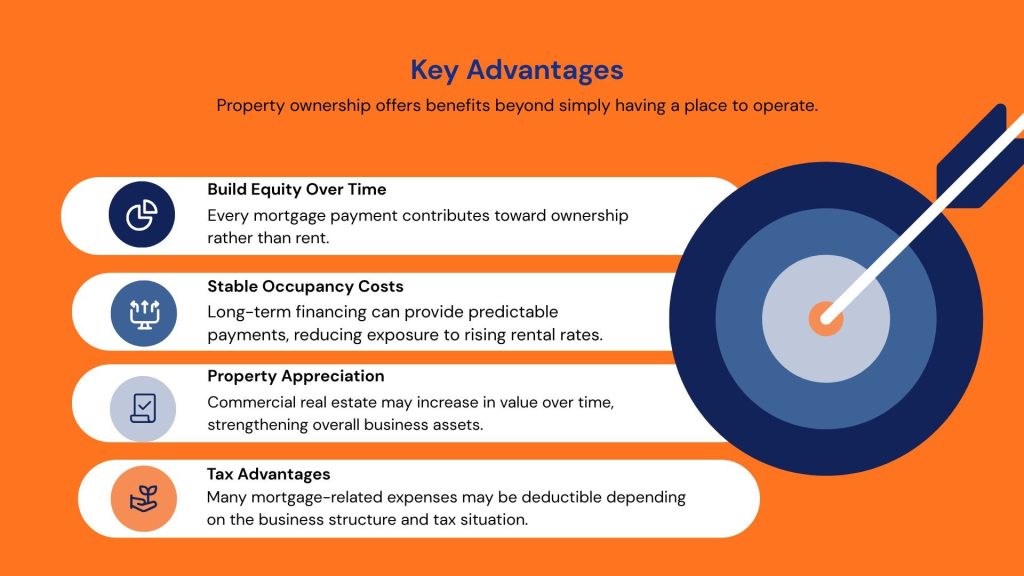
Commercial Mortgage vs Leasing
| Factor | Commercial Mortgage | Leasing |
| Ownership | Builds equity | No ownership |
| Monthly Cost | Mortgage payment | Rent payment |
| Long-Term Value | Asset appreciation | No asset growth |
| Property Control | High | Limited |
| Customization | Flexible | Subject to landlord approval |
| Investment Potential | Yes | No |
Owner-Occupied Commercial Mortgages
For businesses that do business outside the property they buy.
- Some examples are:
- Medical clinics
- attorney offices
- Retail outlets
- Plants
The business is directly occupying the property, and these mortgages are often viewed in a positive light.
Investment Commercial Mortgages
Used to purchase income-producing commercial properties.
Examples include:
- Office rental buildings
- Retail plazas
- Industrial rental units
Lenders typically evaluate rental income potential alongside borrower qualifications.
Business mortgage financing
Refinancing allows businesses to:
- Access equity
- Lower borrowing costs
- Consolidate debt
- Improve cash flow
Mortgage for Small Business Owners Canada

Many entrepreneurs assume commercial property ownership is only for large corporations.
In reality, there are business mortgage financing solutions designed specifically for small and medium-sized businesses.
Businesses Commonly Eligible
- Restaurants
- Retail shops
- Professional service firms
- Auto repair services
- Medical procedures
- Agricultural businesses
- Logistics companies
Lenders typically consider:
- Business profits
- Cash flow consistency
- Credit history
- Down deposit
- Property value
- Industry threat
Typical Commercial Mortgage Requirements
While requirements vary by lender, most applicants should prepare:
| Requirement | Purpose |
| Business financial statements | Evaluate financial health |
| Tax returns | Verify income |
| Property appraisal | Determine value |
| Business plan | Assess development strategy |
| Credit history | Measure repayment risk |
| Down payment | minimize lender risk |
Strong documentation often improves approval chances and financing terms.
Understanding Loan-to-Value Ratios
Commercial lenders commonly use Loan-to-Value (LTV) ratios when evaluating applications.
Example
Property Value: $1,000,000
Maximum LTV: 75%
Potential Financing:
$750,000 Mortgage
Required Equity:
$250,000 Down Payment
Higher down payments may improve financing conditions and interest rates.
Estimated Financing Structure
Commercial Property Purchase Example
| Item | Amount |
| Real Estate Price | $1,000,000 |
| Down Payment (25%) | $250,000 |
| Mortgage Value | $750,000 |
| Amortization | 25 Years |
| Monthly Fee | Varies by Rate |
Growth Impact of Property Ownership
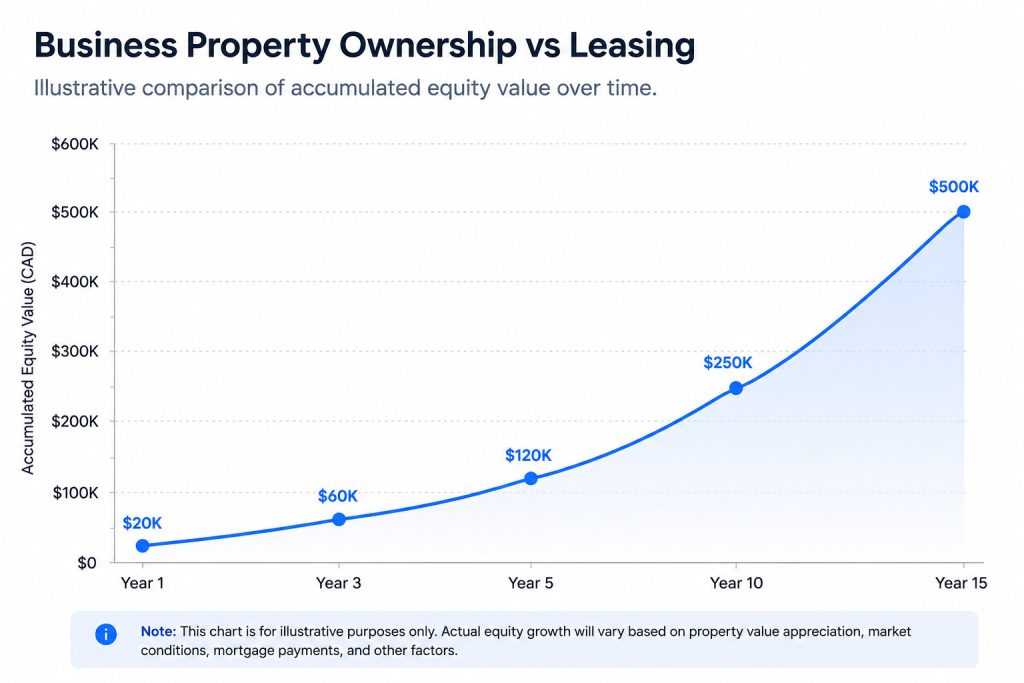
The following chart shows a brief contrast between building equity through purchase versus paying rent over time.
Adaptive Business Finance Options
Not every business follows the same growth path.
Modern lenders increasingly offer adaptive business finance options that allow companies to tailor financing structures to their unique circumstances.
Examples include:
Flexible Payment Structures
Seasonal businesses may profit from payment schedules consistent with revenue cycles.
Interest-Only Periods
Useful during growth or construction stages.
Equity-Based Financing
Allows businesses to leverage existing land value.
Hybrid Financing Models
Combining mortgages with working capital resources can improve cash flow management.
When Business Mortgage Financing Makes Sense
Commercial property ownership may be worth considering when:
- Rent costs keep rising
- Business operations demand stability
- Expansion strategies entail additional space
- Long-term residence is expected
- The business has enough cash flow for mortgage responsibilities
Industries Benefiting Most from Commercial Mortgages
Healthcare
Medical practices often require unique facilities and long-term occupancy.
Manufacturing
Ownership ensures operational flexibility and room for development.
Retail
Prime locations can become valuable long-term assets.
Agriculture
Farm and agricultural businesses frequently use property financing to support growth and succession planning.
Logistics and Warehousing
Growing e-commerce demand continues to increase warehouse property needs.
Business Mortgage Financing Approval Process

Step 1: Determine Financing Needs
Identify property type, budget, and preferred repayment framework.
Step 2: Collect Documentation
Prepare financial reports, tax records, and business strategies.
Step 3: Property Evaluation
An assessment establishes market value.
Step 4: Underwriting Assessment
Lenders assess financial capacity and risk.
Step 5: Approval and Closing
Legal documentation has been submitted, and funds have been released.
Common Challenges Businesses Face

While commercial mortgages offer many benefits, businesses should prepare for possible challenges.
Larger Down Payments
Commercial structures often require more initial capital than residential purchases.
Comprehensive Financial Reviews
Lenders conduct thorough due diligence.
Market Fluctuations
Property values can rise or fall according to economic conditions.
Interest Rate Changes
Financing costs may shift over time.
Proper planning can help businesses overcome these challenges.
Future Trends in Canadian Business Mortgage Finance
Several trends are shaping the commercial financing landscape:
- Increased digital loan applications
- Faster underwriting technology
- Flexible financing structures
- Sustainability-focused lending programs
- Growth in mixed-use commercial developments
These developments are expected to improve access to funding for Canadian small businesses.
Conclusion
Business mortgage financing can be a powerful tool for businesses seeking long-term stability, equity growth, and greater control over their operating space. Many Canadian companies are opting for ownership as part of a broader growth strategy instead of pouring a lot of capital into rent.
Whether you are thinking of a mortgage for small business owners in Canada, refinancing your current property or considering your adaptive business finance options, the right financing structure can help you achieve your short-term operational needs and long-term wealth-building goals.
As with any large financial undertaking, careful planning, good financial documentation, and a clear understanding of your business objectives are key. With the right approach, owning commercial property can be one of the most valuable investments your business makes.
FAQ
1. What is business mortgage financing?
A loan used to purchase, refinance, or improve commercial property for business purposes.
2. Can small business owners get a commercial mortgage in Canada?
Yes, many lenders offer mortgages specifically for small business owners.
3. What properties can be financed?
Offices, retail stores, warehouses, industrial buildings, and mixed-use properties.
4. How much down payment is usually required?
Typically 15%–35%, depending on the lender and property type.
5. What documents are needed?
Financial statements, tax returns, credit information, and property details.
6. Can I refinance a business mortgage?
Yes, refinancing can help access equity or improve cash flow.
7. What is Loan-to-Value (LTV)?
The percentage of a property’s value that a lender is willing to finance.
8. Are startups eligible for business mortgages?
Some lenders finance startups, often with stricter requirements.
9. What are adaptive business finance options?
Flexible business mortgage financing tailored to a business’s cash flow and growth needs.
10. Is commercial mortgage interest tax deductible?
In many cases, interest expenses may be deductible; consult a tax professional.
11. How long does approval take?
Usually a few weeks, depending on the lender and application complexity.
12. Is buying better than leasing?
Buying builds equity, while leasing offers greater flexibility and lower upfront costs.