

I have spoken with hundreds of Canadian entrepreneurs who hit the same wall. They have a solid idea, a real plan, and genuine drive — but the moment someone mentions business loans, they freeze. The paperwork feels endless. The rules seem buried in bureaucracy. And nobody can give them a straight answer.
Here’s what I want you to know: the system is actually simpler than it looks once you strip out the noise.
Lenders aren’t trying to trick you. They want to say yes. But they need to see three things clearly — why you need the money, where it’s going, and how you’ll pay it back. That’s the core of every business loan decision in Canada.
• Canadian small businesses can access government-backed loans up to $1.15 million through the CSBFL programme.
• BDC loans offer flexible terms, including options for startups with limited credit history.
• The right loan matches your purpose: equipment, real estate, working capital, or acquisition.
• A well-written business plan is the single biggest factor in getting approved.
• Small business loans for women are available through BDC and several provincial programmes.
Whether you’re launching a franchise, buying out a partner, or just trying to smooth out a cash flow gap, there’s a financing option that fits. Small business loans in Canada in 2026 are more accessible than most people realize. Let’s walk through all of it.
What Types of Business Loans in Canada Are Actually Available?
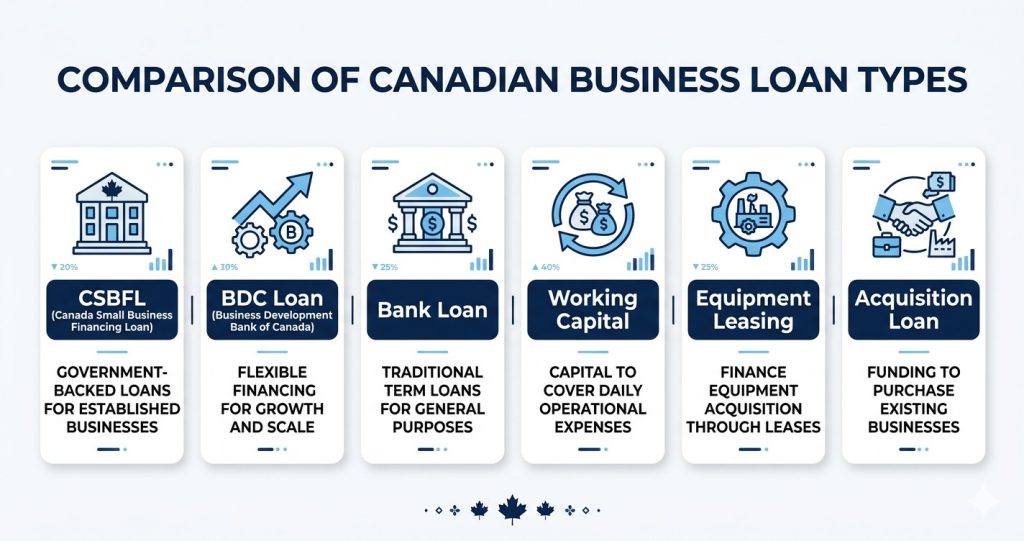
Canadian entrepreneurs can choose from government-backed CSBFL loans, BDC financing, traditional bank loans, equipment leasing, working capital lines of credit, and business acquisition financing.
Not every loan product is right for every stage of business. Applying for the wrong one wastes time, leaves marks on your credit file, and sets you back. Here’s the clearest breakdown I can give you:
| Loan Type | Best For | Max Amount | Backed By |
| CSBFL (Govt-Backed) | Equipment, real estate, leaseholds | $1.15M | Federal government |
| BDC Loan | Startups, flexible needs | Varies | Crown corporation |
| Traditional Bank Loan | Established businesses | Varies | Major chartered banks |
| Working Capital Line of Credit | Daily operations, payroll, and stock | Varies | Banks / Alt lenders |
| Equipment Leasing | Machinery, vehicles, technology | Asset value | Private lenders |
| Business Acquisition Loan | Buying an existing business | Varies | Banks, BDC, private |
Each of these has its own rules, timelines, and costs. The business loans that work best for a five-year-old retail shop look very different from what’s right for a first-time franchise buyer. Understanding where you sit on that spectrum is the first step.
How Do Small Business Loans in Canada Actually Work?
A lender advances capital to your business. You repay it over time, with interest. Government-backed programmes reduce the lender’s risk — making approval far more likely for newer or smaller businesses.
Think of it like renting a piece of expensive equipment. You pay to use it while it generates revenue for you. At the end of the term, the cost is settled. The interest rate is essentially the rental fee on someone else’s money.
Where people get confused is on the qualification side. Every lender runs through the same mental checklist when they read your file:
What Every Lender Checks Before Saying Yes
1. Credit history — both your personal score and any existing business credit.
2. Cash flow — real evidence that your monthly revenue can absorb the repayment.
3. Collateral — what you’re putting up if things go sideways.
4. Business plan — your roadmap, financial projections, and market case.
5. Time in business — startups get more scrutiny; established firms get more flexibility.
A polished business plan is the one document that speaks to all five of those concerns at once. That’s why lenders ask for it before they ask for almost anything else. It tells them whether you’ve actually thought this through — or just hope it’ll work out.
The CSBFL: Canada’s Best-Kept Secret for Small Business Loans in Canada
The Canada Small Business Loans (CSBFL) is a federal program where Ottawa guarantees up to 85% of your loan. Banks lend with far less risk — so they approve applications they’d normally decline.
I call this Canada’s best-kept secret because the approval rates are genuinely higher than conventional lending, and yet a huge portion of eligible business owners have never heard of it.

Here are the mechanics in plain language. You go to a bank. The bank lends you money. If your business hits trouble and you can’t repay, the federal government covers 85 cents of every dollar lost. The bank barely blinks. That’s why they’re willing to work with startups, newer businesses, and owners who don’t have a pile of assets to pledge as collateral.
Who Can Apply for a CSBFL?
- Canadian for-profit businesses with annual revenues under $10 million
- Startups and new businesses — no minimum operating history required
- Businesses in most sectors except farming (separate programs cover agriculture)
What Can You Use the Money For?
- Purchasing or renovating commercial real estate
- Buying or upgrading equipment and machinery
- Leasehold improvements to your business premises
- Working capital needs — up to $150,000 under the current program rules
- Intangible assets, including software licences and franchise fees
The maximum loan is $1.15 million. There’s a 2% registration fee, but it can be rolled directly into the loan so you don’t need to come up with it upfront. For most small business loan seekers in Canada, this programme is the first place to look.
Is a BDC Loan the Right Fit for Your Business?
A BDC loan comes from the Business Development Bank of Canada — a Crown corporation whose only job is to help Canadian businesses grow. It’s more flexible than a chartered bank, especially for startups and businesses that have been turned down elsewhere.
The BDC operates differently from any other lender in Canada. It doesn’t have shareholders to protect. It isn’t chasing quarterly profit targets. Its entire mandate — written into federal law — is to support Canadian entrepreneurs.
That means a BDC loan can be structured in ways that a traditional bank simply won’t consider. Interest-only repayment periods while you’re getting started. Higher loan-to-value ratios. Softer qualification standards for businesses without years of financials.
A BDC Loan Makes Sense When:
- You’re a start-up without two full years of audited financial statements
- You need to finance soft costs like training, shipping, or installation
- A chartered bank has already said no to your application
- You want advisory support included alongside your financing
BDC also covers growth capital, technology loans, and business loans in Canada, which means if you’re buying an existing company, they’re one of the few lenders that’ll actually structure the deal with you from scratch.
Where to Find Small Business Loans for Women in Canada
Yes, Canada has dedicated financing programmes for women entrepreneurs through BDC, WEOC, and Futurpreneur. These go beyond lending to include mentorship and peer networks that improve long-term outcomes.

Alt: A Canadian woman entrepreneur presenting a business plan to investors in a co-working space and shaking hands.
The financing gap for women-owned businesses in Canada is well-documented. Women are statistically more likely to be denied credit, offered smaller amounts, or charged higher rates than men with equivalent business profiles. That’s the bad news.
The better news: there are programmes designed specifically to close that gap, and most business owners don’t know they exist.
Programs Worth Knowing About
• BDC Financing for Women Entrepreneurs — tailored loans with mentorship built in, not just capital.
• BDC Women in Technology Fund — venture-style capital for women-led technology businesses.
• Women’s Enterprise Organizations of Canada (WEOC) — regional lenders and advisory services across the country.
• Futurpreneur Canada—financing and structured mentoring for entrepreneurs aged 18–39, with a dedicated stream for women.
These programmes exist because the data shows that small business loans for women with mentorship attached have significantly higher survival rates at the five-year mark. Don’t walk past them on your way to a bank that doesn’t know your name.
How Business Acquisition Loans Canada Work in Practice
Business loans in Canada finance the purchase of an existing operation. They typically blend a bank loan, BDC component, and sometimes vendor take-back financing — and they require a very detailed business plan.
Buying an existing business is one of the smartest moves an entrepreneur can make. The customer base is already there. The staff are trained. The revenue history is real. You’re not guessing — you’re buying proof.
But acquisition financing is a different animal from a standard equipment loan. The stakes are higher. The due diligence is deeper. And the structure of the deal itself becomes part of the application.
What Lenders Dig Into on an Acquisition File
• Why the current owner is selling — and what it means for the business going forward
• Three to five years of the target business’s financial statements
• Your post-acquisition plan: how you’ll run and grow the operation
• Your own financial strength and relevant industry experience
Business loans in Canada usually come together as a stack: a bank takes the main loan, BDC covers a supplementary tranche, and the seller sometimes agrees to take a portion of the price over time (called vendor take-back financing). Structuring this correctly requires expertise — and getting it wrong can collapse a deal that would have otherwise gone through.
Working Capital vs Term Loans: Which Type of Business Loans Should You Use?
A term loan delivers a fixed lump sum for a specific purpose and is repaid on a set schedule. Working capital financing gives you a reusable credit line to cover ongoing costs like payroll, inventory, and supplier invoices.
This distinction matters more than most people think — because applying for the wrong type can result in a rejection that would never have happened with the right product.
The simplest way I have found to explain it: a term loan is like buying a piece of equipment on a payment plan. A working capital line of credit is like a reserve fuel tank — it’s there when you need it, you top it up as you repay, and you only pay interest on what you actually use.
Use a Term Loan When:
• You’re making a major, one-time capital purchase—equipment, property, a renovation
• The amount is fixed, and the purpose is clear
• You are financing a business acquisition

Use a Line of Credit When:
• You need to manage seasonal swings in revenue or expenses
• Payroll timing doesn’t always align with client payment timing
• Suppliers offer early-payment discounts you want to take advantage of
Many established Canadian businesses carry both simultaneously. That’s not a sign of financial strain — it is sound treasury management. The business loans that get businesses into trouble are the ones applied to the wrong problem.
What the Top Business Consulting Companies in Canada Do Differently
Top business consulting companies in Canada do more than write a plan — they stress-test your numbers, identify lender objections before submission, and structure your application to match exactly what each programme requires.
There’s a reason some business owners walk into a bank with a DIY plan and walk out empty-handed, while others who work with an experienced consultant get approved within weeks.
It is not about the formatting. It’s not about length. It’s about knowing what a specific lender is looking for on a CSBFL file versus a BDC application versus a chartered bank submission. Those are three different audiences with three different priorities.
What to Look for in a Consulting Partner
• Hands-on experience with CSBFL and BDC applications — not just general business planning
• A real track record: named industries, approval amounts, client outcomes
• Industry-specific knowledge in your sector (restaurant, healthcare, franchise, tech)
• Transparent pricing with defined deliverables — no vague retainer arrangements
• Ongoing support after approval, not just a plan and goodbye
The top business consulting companies in Canada don’t just produce documents. They position your application so the lender’s instinct is confidence. That difference in framing is often worth more than the fee you pay them.
Business Loans in Canada in 2026: What’s Actually Changed
The rules have not been rewritten. But the landscape has shifted enough that what worked two years ago isn’t always the best path now. Here’s what I’m seeing on the ground with business loans in Canada in 2026:
• Demand for flexible credit is up. Operating costs have stayed high, and more business owners are prioritizing lines of credit over fixed-term loans to maintain cash flow flexibility.
• Alternative lenders are moving faster. Non-bank lenders can approve and fund in 48 hours for short-term needs, but rates are meaningfully higher than government-backed programmes.
• Documentation standards haven’t softened. Despite faster fintech tools and online applications, thorough, well-structured documentation still drives approval decisions at every major lender.
• The CSBFL working capital expansion is underused. The $150,000 working capital component was added to the programme and remains one of the least-accessed features—a genuine opportunity many businesses miss.
• Lenders are using automated screening. AI-assisted initial reviews mean sloppy or incomplete applications get filtered faster than ever. A clean, complete file matters more now, not less.
The core advice has not changed: know your purpose, choose the right product, and go in with documentation that leaves no questions unanswered.
Pre-Application Checklist: Are You Ready to Apply for Business Loans in Canada?
Run through this before you submit anything. Every unchecked box is a reason a lender might say no:
☐ I have a clear, specific purpose for the funds — not just ‘grow the business’.
☐ I have identified the right loan program (CSBFL, BDC, bank, alternative lender)
☐ My personal and business credit reports are clean and up-to-date.
☐ I have at least 12 months of financial records — or a strong startup plan with detailed projections
☐ I have a professionally written business plan that addresses lender concerns directly
☐ I understand all fees, including registration fees and the total cost of borrowing
☐ I have spoken with a consultant or advisor who knows Canadian financing programs inside out
If every box is checked, you are ready. If several aren’t, address them first. A declined application is not just a setback — it is a record that follows your file.
Frequently Asked Questions
What are the easiest business loans to get in Canada?
The CSBFL is consistently the most accessible option for small and newer businesses. Because Ottawa guarantees 85% of the lender’s risk, banks are significantly more willing to approve applications, including those from first-time borrowers without years of business history.
How much can I borrow through small business loans in Canada?
Through the CSBFL, you can borrow up to $1.15 million. BDC loan amounts vary based on your business stage and needs. Chartered banks and alternative lenders set their own maximums based on revenue, collateral, and creditworthiness.
Do I need collateral to get business loans in Canada?
Not always. The CSBFL is secured against the specific assets you’re financing. BDC and some alternative lenders offer partially secured or unsecured structures. Most chartered bank loans, however, still require collateral or a personal guarantee — often both.
Can a startup qualify for business loans in Canada?
Yes, and this surprises many people. Both the CSBFL and BDC have programmes specifically designed for early-stage businesses. For startups without financial statements, a well-researched business plan serves as your proof of concept. Working with a consultant on that plan is often the difference between approval and a decline.
How long does approval take for small business loans in Canada?
Chartered bank and CSBFL applications typically run 2–8 weeks, depending on how complete your file is. BDC can move faster if your documentation is clean. Alternative lenders can approve in 24–48 hours, though at considerably higher interest rates. The single biggest variable in speed isn’t the lender. It’s how prepared you are when you walk in.
Ready to Secure Your Business Financing?
At BCSOD, we specialize in CSBFL applications, business plan writing, and financial advisory for Canadian entrepreneurs at every stage. We have helped businesses in restaurants, healthcare, franchising, and beyond secure the capital they needed to grow.