


Creating or developing a business requires more than a great idea. It also takes exposure to the right funding to invest in equipment, manage cash flow, hire employees, or increase operations. Small business loans provide Canadian entrepreneurs with the financial support required to grow while maintaining full ownership of their business. From conventional lenders to government small business loans and BDC loans for small business, there are financing possibilities for every stage of growth. This guide discusses the different types of small business loans Canada offers, eligibility requirements, application tips, and funding opportunities, including programs designed to promote women entrepreneurs.
What Are Small Business Loans?
A small business loan is money obtained from a lender to finance business activities. The borrower agrees to pay back the loan plus interest at some time.
Businesses usually use these loans to:
- Buy equipment
- Operations at scale
- use employees
- Increase the stock
- Increase cashflow
- Renovating commercial property
- Invest in tech.
- Run marketing campaigns
Unlike investors, lenders don’t get equity in your company. After you pay back the loan, your business is still yours.
Why Small Business Loans Matter

Many successful Canadian businesses reached their current position because they secured financing at the right time.
You can use a business loan to:
Accelerate Growth
Saving up capital for years may slow your progress. Access to funding means more growth and more opportunity.
Boost Your Cash Flow
Many seasonal businesses experience situations where expenses keep coming in, but revenue drops off. Financing helps to close these gaps and keep operations running.
Invest in Productivity
New equipment, software, automation, and technology often increase efficiency and decrease operating expenses.
Establish Business Credit
Making on-time payments on your loans builds your business credit profile, which could make it easier to obtain financing down the road.
Types of Small Business Loans Canada Offers
Not every loan serves the same purpose. Understanding your options helps you choose financing that matches your business goals.
Term Loans
A term loan provides a lump sum that is repaid through fixed monthly payments over several years.
These loans are commonly used for:
- Business development
- Tools purchases
- Office refurbishment
- Massive investments
They usually offer established repayment schedules, making budgeting easier.
Business Line of Credit
Unlike a traditional loan, a business line of credit allows you to borrow only what you need.
Benefits include:
- Flexible loans
- Interest charged only on the amount used
- Better cash flow management
- Ongoing exposure to capital
This option works well for businesses with fluctuating expenses.
Equipment Financing
Equipment loans allow businesses to purchase machinery, vehicles, manufacturing equipment, computers, or specialized tools.
Since the equipment often serves as collateral, approval may be easier than for unsecured financing.
Commercial Mortgage
Businesses purchasing office buildings, warehouses, retail stores, or industrial properties often utilize commercial mortgages.
These loans usually offer longer repayment periods due to the higher investment.
Working Capital Loans
Working capital financing funds everyday operations rather than long-term investments.
Businesses frequently use these loans for:
- Payroll
- Inventory
- Rent
- Utilities
- Supplier payments
Government Small Business Loans

Many entrepreneurs search for government small business loans because these programs often supply more affordable financing than conventional lending alternatives.
Government-backed funding encourages entrepreneurship, innovation, and job creation across Canada.
Typically, these programs provide:
- Reduced borrowing risk
- Attractive Interest Rates
- Extended loan terms
- More accessible for eligible businesses
The government financing can also help companies in sectors like manufacturing, agriculture, technology, clean energy, and export development.
Depending on your type of business, government assistance may include:
- Guarantees on loans
- Direct finance
- Grant’s
- Wage subsidies.
- Funding Innovation
- Programmes of Regional Development
Understanding a BDC Loan
A BDC loan provides financing through the Business Development Bank of Canada, a federal Crown corporation dedicated to supporting Canadian entrepreneurs.
Unlike traditional banks, BDC focuses solely on helping Canadian businesses start, grow, innovate, and expand internationally.
There are some industries where you can get BDC financing for companies, such as:
- Manufacturing
- The Professional Services
- Tech
- Retailing
- Constructing
- care health
- Agriculture Trade Transport
Beyond financing, BDC offers valuable business consulting and advisory services that assist companies in improving their operations and long-term performance.
Benefits of BDC Loans for Small Business
Many entrepreneurs particularly utilize BDC loans for small business because they are designed around the particular challenges faced by expanding companies.
Some of the main benefits are the following:
Flexible Financing
There is not a single BDC lending product that fits all, but financing solutions designed for each stage of business growth do exist.
Extended repayment periods
Longer installment terms can help minimize monthly payment expenses and enhance cash flow.
Growth-Focused
The purpose of BDC financing is to fund business growth, not just to keep a business running.
Business Know-How
In addition to providing loans, BDC consultants assist entrepreneurs in improving their planning, financial management, marketing, and operational efficiency.
Support of Innovation
Common areas of assistance with BDC financing are technology utilization, automation, digital transformation, and productivity improvements.
Small Business Loans for Women
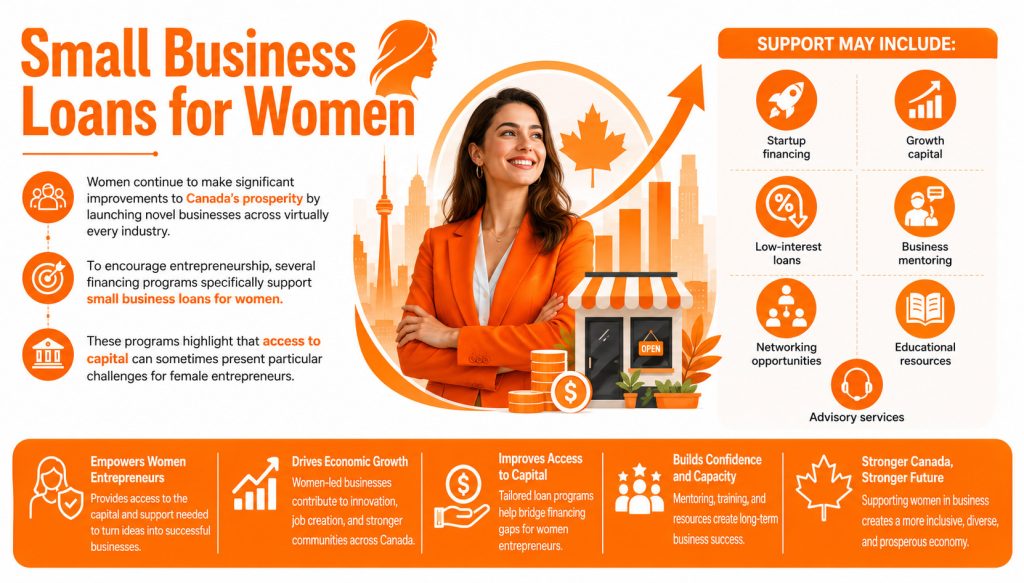
Women continue to make significant improvements to Canada’s prosperity by launching novel businesses across virtually every industry.
To encourage entrepreneurship, several financing programs specifically support small business loans for women.
These programs highlight that access to capital can sometimes present particular challenges for female entrepreneurs.
Support may include:
- Startup financing
- Growth capital
- Low-interest loans
- Business mentoring
- Networking opportunities
- Educational resources
- Advisory services
Many lenders also associate with organizations that focus on helping women-owned businesses secure financing while building profitable long-term growth.
Whether launching a home-based business or expanding an established company, women entrepreneurs have access to an expanding number of funding opportunities across Canada.
Documents Required for a Small Business Loan in Canada
Preparing the right documents before applying for a small business loan can improve your chances of approval and accelerate the lending process. While requirements vary by lender, most financial institutions, including banks and BDC, ask for the following information.
1. Business Plan
A complete business plan helps lenders understand your company, products or services, desired market, growth strategy, and how you will use the loan. It should also contain realistic financial projections and revenue forecasts.
2. Business Registration Documents
You will usually require proof that your business is legally registered. This may include:
- Business registration certificate
- Articles of Organization (if incorporated)
- Partnership agreement (if applicable)
- Business license or permits
3. Financial Statements
Lenders evaluate your financial health before approving a loan. Commonly requested statements include:
- Balance sheet
- Income statement (Profit and Loss)
- Cash flow statement
Established businesses are usually asked to provide statements for the past one to three years.
4. Tax Returns
Business and, in some cases, personal tax returns allow lenders to verify your income and assess your repayment capacity. Many lenders request the last two or three years of filed tax returns.
5. Bank Statements
Recent business bank statements, often detailing the last three to twelve months, help illustrate cash flow, revenue stability, and day-to-day financial activity.
6. Cash Flow Forecast
A cash flow projection shows how your business expects to generate income and manage expenses over the coming months. This paperwork reassures lenders that you can meet future loan repayments.
7. Personal Identification
Business owners are generally required to provide government-issued identification, such as:
- Driver’s license
- Passport
- Provincial or territorial photo ID
8. Proof of Business Ownership
Lenders may request documents that verify the ownership of the business, including shareholder information or ownership agreements.
9. Loan Purpose and Cost Estimates
Clearly explain how the funds will be used. Supporting documents may include:
- Equipment quotations
- Supplier statements
- Purchase agreements
- Commercial property details
- Project budgets
Providing accurate estimates helps lenders evaluate the purpose and value of the financing.
10. Collateral Information (If Required)
For secured small business loans, lenders may ask for details about assets offered as collateral, such as:
- Commercial property
- Equipment
- Vehicles
- Inventory
- Other business assets
Tips Before You Apply
To improve your chances of approval:
- Ensure all financial records are accurate and up to date.
- Pay outstanding taxes and address any discrepancies.
- Review your business and personal credit reports.
- Organize all documents in digital and printed formats.
- Be prepared to explain how the loan will support business growth and how you plan to repay it.
Having these documents ready exhibits professionalism, reduces delays during the application process, and increases your probability of securing the right financing for your business.
Common Mistakes to Avoid When Applying for Small Business Loans
Getting a small business loan is a crucial step in growing your business, but even a good business can run into delays or denial when the application isn’t prepared properly. Avoiding these common mistakes can help you improve your chances of securing financing and build a good relationship with lenders.
1. Having No Business Plan in Place
Many business owners underestimate how important a detailed business plan is. Lenders want to know about your business model, target market, financial projections, and how you will use the loan. A good plan shows that you have a clear strategy for growth and repayment.
2. Borrowing More Than You Need
Requesting more cash than your business needs can cause lenders to question your ability to handle debt. Carefully calculate your funding needs and only borrow what is necessary to support your business objectives.
3. Inadequate or Incorrect Records
Incomplete documents, outdated financial statements, or inaccurate information can slow down the approval process or lead to a declined application. Before you submit your application, please make sure all required documentation is complete, accurate, and up-to-date.
4. Overlooking Your Credit Profile
Many lenders will review both personal and business credit histories. If you have bad credit or any other financial issues, you might not qualify. Before you apply, check your credit reports, correct any errors and pay your bills on time if you can.
5. Bad Cash Flow Management
Even profitable businesses can struggle to obtain financing if they have irregular cash flows. Lenders want to know that your business produces enough income to comfortably meet monthly loan repayments. Strong cash flow history? That can help your application.
6. Selecting the Wrong Loan Product
Not all financing options are right for all businesses. If you select the wrong kind of small business loan, it could cost you more money or make it more difficult to repay. Compare options such as term loans, lines of credit, equipment financing, BDC loans for small business and government small business loans to see what is the best option for your needs.
7. Not Explaining How The Money Will Be Used
Lenders want to understand how the loan will help your business. A detailed funding plan will go a long way in strengthening your application if you are looking to buy equipment, hire employees, expand your operations, or improve your cash flow.
8. Applying to Several Lenders at a Time
Applying for many loans in a short period of time can hurt your credit profile and may lead to the perception that your business is in financial trouble. Shop lenders carefully and only apply with those that match your financing needs.
9. Rejecting Sources of Financing from Government and BDCs
Some business owners only look to traditional banks and miss out on valuable funding opportunities. Government small business loans, BDC loans for small businesses, and small business loans for women programs can offer more flexible eligibility requirements, competitive terms, and additional business support.
10. Not Getting Professional Advice
If you’re unsure which financing option is right for your business, you might want to consider talking to a financial advisor, accountant, or business financing specialist. A professional can help you assemble a stronger application, choose the right lender, and avoid costly mistakes.
Final Thoughts
But qualifying for a small business loan means more than just meeting the requirements. Lenders want to see ready businesses, you can boost your chances of approval and secure the financing you need to achieve your business goals.
FAQ
What Is a Small Business Loan?
Small business loans are one kind of financing that helps companies pay for things like buying equipment, inventory, payroll, marketing, expanding the business, or working capital. The loan is repaid, with interest, over an agreed period.
Who Can Get Small Business Loans in Canada?
Eligibility for a small business loan Canada depends on your business revenue, credit history, time in business, financial statements, and ability to pay back the loan, but it can vary from lender to lender. Some lenders also take into account your business plan and cash flow.
What is a BDC loan? BDCs also make loans.
A BDC loan is funding from the Business Development Bank of Canada (BDC). The program helps Canadian entrepreneurs start, grow, modernize, and expand their businesses with flexible repayment terms and expert business support.
How do BDC loans work for small business?
BDC loans for small business financing equipment, technology, commercial property, business expansion, and working capital. The business then repays the loan via monthly installments on a mutually agreed-upon schedule and at a rate of interest.
Are there government small business loans in Canada?
Yes. There are several government small business loans and government-backed financing programs available to help you as an entrepreneur. These programs may include loan guarantees, startup funding, innovation funding, export support, or industry-specific funding opportunities.
Can women business owners apply for small business loans?
Definitely. There are a plethora of financial institutions and organizations that provide small business loans for women, mentorship programs, business training, and networking opportunities to assist female entrepreneurs at all stages of business growth.
They may require additional documentation, depending on the lender and loan amount.
Can a startup get a small business loan in Canada?
Indeed. Many startups qualify for small business loans Canada, especially through government-backed programs, BDC financing, community lenders, or alternative financing sources. A sound business plan and realistic financial projections can improve your chances.
How do I find the right small business loan for my company?
What is the best small business loan? The best loan for your small business will depend on your funding needs, ability to repay, interest rates, loan terms, and business goals. Look at lenders and financing options (banks, credit unions, BDCs, and government-backed programs) and compare before you decide.