


Every business confronts challenges at multiple levels of its journey. Whether it is enhancing financial performance, managing risk, entering into new markets, or keeping up with changing buyer expectations, making the right decisions is critical. This is where business advisory services contribute significant value.
Many organizations depend on experienced professionals to monitor business performance, determine opportunities, and recommend strategies that support sustainable growth. Unlike one-time consulting engagements, business advisory focuses on building long-term success through proactive planning, operational improvements, and informed decision-making.
In this guide, we’ll explain what business advisory services are, how they benefit businesses of all sizes, and why many organizations partner with consulting firms or a trusted business consultancy to accomplish their goals.
What Are Business Advisory Services?
Business advisory services pertain to professional advice that helps organizations optimize performance, fix operational challenges, and meet strategic objectives. Advisors work extensively with business owners, executives, and management teams to analyze prevailing operations and develop practical solutions.
Rather than concentrating on a single issue, advisors examine multiple aspects of the business, including:
- Business strategy
- Financial performance
- Operations
- Risk management
- Digital transformation
- Market expansion
- Process improvement
- Organizational growth
The purpose is to deliver practical recommendations that optimize efficiency, profitability, and long-term viability.
Why Businesses Need Professional Advisory Support
Today’s business environment changes quickly. Economic unpredictability, technological advancement, changing regulations, and increasing rivalry make strategic planning more important than ever.
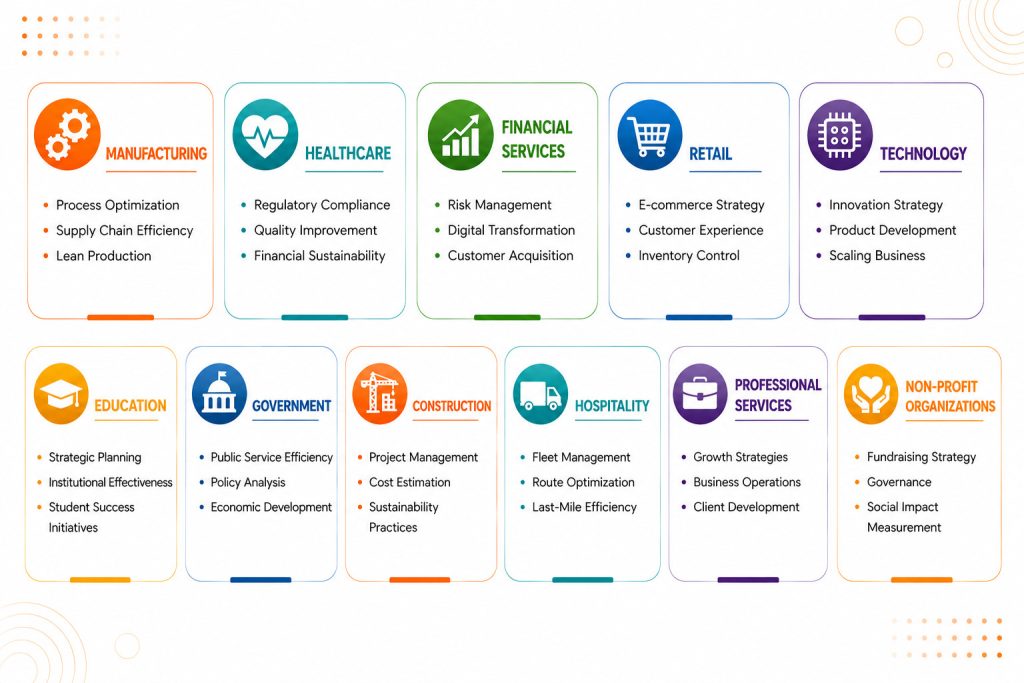
Professional business advisory services help organizations:
- Make informed decisions
- Improve operational efficiency
- Reduce unnecessary costs
- Identify growth opportunities
- Strengthen financial planning
- Prepare for future risks
- Improve customer satisfaction
- Support long-term business success
Businesses often benefit from an external perspective because advisors can identify challenges that internal teams may overlook.
Common Areas Covered by Business Advisory Services
Professional advisory support reaches across many business functions.
Strategic Business Planning
A clear strategy provides direction for long-term growth. Advisors review current performance, market conditions, and competitive standing before developing feasible business plans.
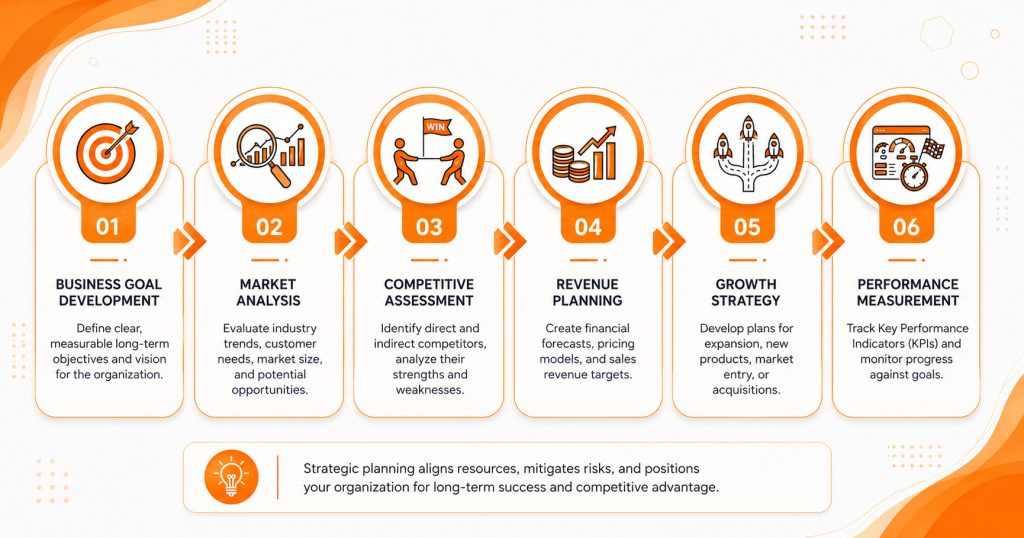
Strategic planning often includes:
- Business goal development
- Market analysis
- Competitive assessment
- Revenue planning
- Growth strategy
- Performance measurement
These activities help organizations stay focused on measurable objectives.
Financial Advisory
Strong financial management is the foundation of every successful business.
Financial advisory may include:
- Budget planning
- Cash flow management
- Profitability analysis
- Financial forecasting
- Investment planning
- Cost optimization
- Business valuation
Accurate financial findings allow business leaders to make prudent decisions based on accurate data.
Operational Improvement
Many organizations lose productivity because of inefficient processes.
Business advisors review daily operations to identify opportunities for improvement.
Common recommendations include:
- Workflow optimization
- Resource allocation
- Process automation
- Performance monitoring
- Operational efficiency improvements
- Quality management
Small operational improvements often lead to significant long-term savings.
Risk Management
Every business faces risks ranging from financial uncertainty to cybersecurity threats.
Professional business advisory services help organizations identify, assess, and manage potential risks before they become major problems.
Risk advisory may cover:
- Operational risk
- Financial risk
- Compliance risk
- Technology risk
- Business continuity planning
- Crisis management
A proactive approach reduces disruption and improves organizational resilience.
Digital Transformation
Modern businesses increasingly rely on digital technologies to improve efficiency and customer experience.
A professional business consultancy can help organizations adopt new technologies while minimizing implementation challenges.
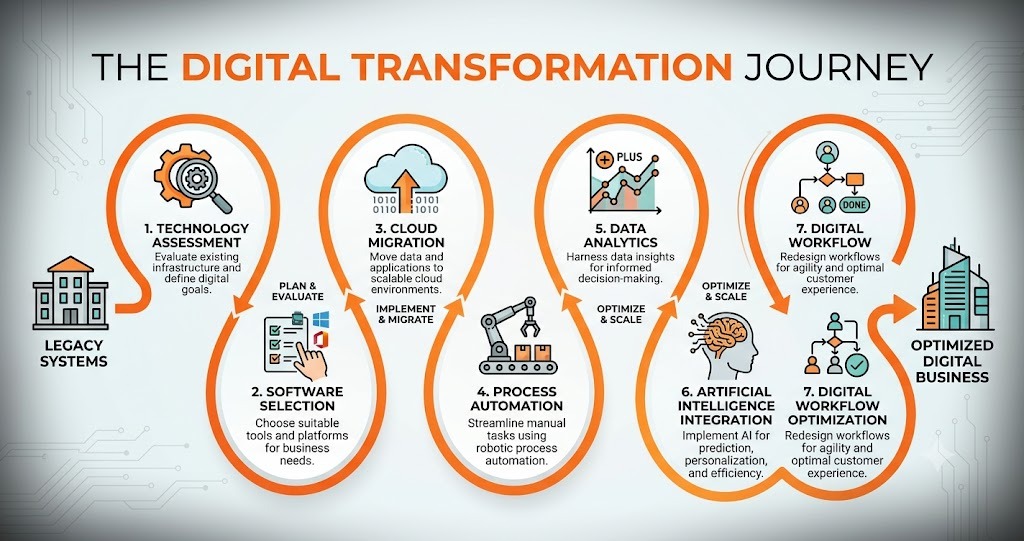
Digital advisory often includes:
- Technology assessment
- Software selection
- Cloud migration
- Process automation
- Data analytics
- Artificial intelligence integration
- Digital workflow optimization
Technology investments become more successful when supported by strategic planning.
Benefits of Working with Consulting Firms
Many organizations choose established consulting firms because they provide specialized expertise across multiple industries.
Some key advantages include:
Independent Perspective
Internal teams sometimes become comfortable with existing processes. Outside advisors provide unbiased recommendations supported by industry experience.
Specialized Knowledge
Experienced professionals comprehend market trends, statutory changes, and industry best practices that can impact business performance.
Faster Problem Solving
Rather than spending months identifying solutions, advisors use proven methodologies to address complex business challenges efficiently.
Improved Decision Making
Reliable business analysis helps leaders make informed decisions supported by data rather than assumptions.
Scalable Support
Businesses can access expertise only when needed without hiring permanent specialists.
Choosing the Right Business Consultancy
Selecting the right business consultancy is an important decision.
Consider the following factors:
Industry Experience
Choose advisors who understand your industry, business model, and operational challenges.
Proven Methodology
A planned advisory process typically produces more consistent results than informal recommendations.
Communication
Effective advisors articulate complex business issues concisely and maintain regular interaction throughout the project.
Customized Solutions
Avoid one-size-fits-all approaches. Every organization has specific objectives and challenges.
Long-Term Partnership
Many businesses produce better outcomes by building ongoing advisory relationships rather than looking for occasional assistance.
Industries That Benefit from Business Advisory Services
Almost every industry can benefit from professional advisory support.
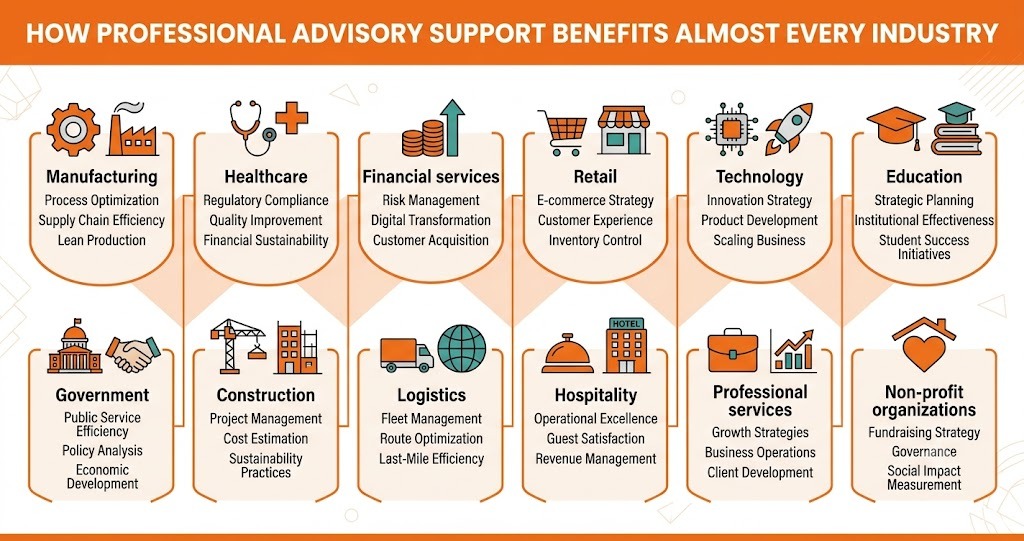
Examples include:
- Manufacturing
- Healthcare
- Financial services
- Retail
- Technology
- Education
- Government
- Construction
- Logistics
- Hospitality
- Professional services
- Non-profit organizations
Each industry presents unique operational, regulatory, and financial challenges that require specialized guidance.
How Business Advisory Services Support Business Growth
Growth requires more than increasing sales. Long-term expansion requires thorough planning and effective management.
Professional business advisory services promote growth by helping organizations:
- Identify new markets
- Improve customer experience
- Boost operational efficiency
- Strengthen financial management
- Develop leadership capabilities
- Improve employee productivity
- Expand service offerings
- Optimize resource efficiency
These improvements contribute to long-term competitive advantage.
The Difference Between Business Advisory and Traditional Consulting
Although the terms are sometimes used together, they often vary in scope.
Traditional consulting generally depends on solving a specific problem or completing a specified project.
In contrast, business advisory services usually involve ongoing strategic guidance that supports continuous improvement across multiple business areas.
Many organizations work with consulting firms for project-based initiatives while keeping a long-term relationship with a trusted business consultancy for strategic planning and business development.
Signs Your Business May Need Advisory Support
Organizations often seek advisory assistance when they experience:
- Declining profitability
- Slow business growth
- Operational inefficiencies
- Cash flow challenges
- Rapid expansion
- Market uncertainty
- Digital transformation initiatives
- Leadership transitions
- Regulatory changes
- Business restructuring
Seeking professional guidance early often prevents larger problems from developing later.
Future Trends in Business Advisory Services
Business advisory continues to evolve alongside technology and changing market expectations.
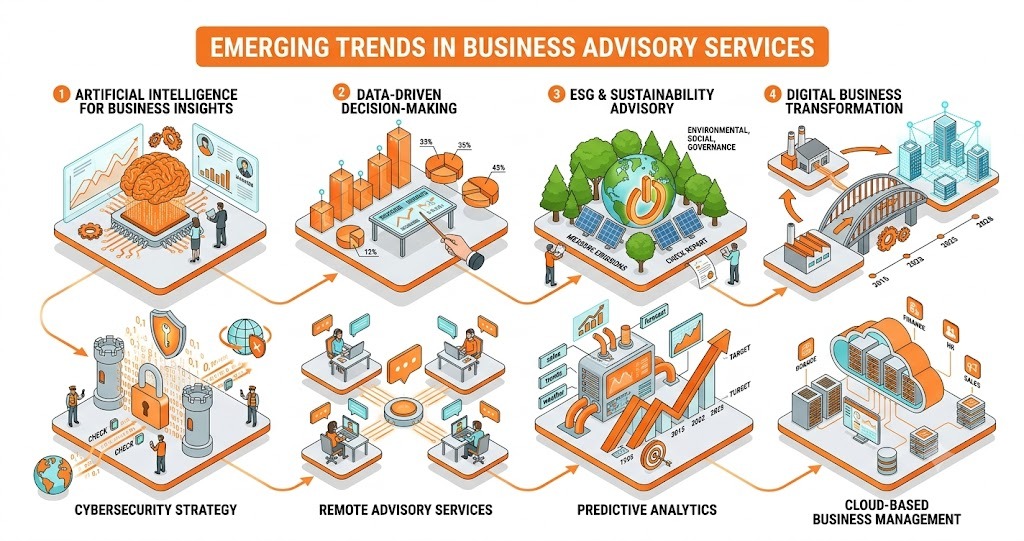
Emerging trends include:
- Artificial intelligence for business insights
- Data-driven decision-making
- ESG and sustainability advisory
- Digital business transformation
- Cybersecurity strategy
- Remote advisory services
- Predictive analytics
- Cloud-based business management
Organizations that adapt to these developments are often better positioned for long-term success.
Conclusion
Every organization faces unique challenges, but informed decision-making is the foundation of lasting growth. Business advisory services provide proactive guidance that allows businesses to improve productivity, manage risk, bolster financial planning, and identify new opportunities.
Whether you’re launching a start-up, expanding operations, or modernizing existing processes, experienced consulting firms and a trusted business consultancy can provide valuable insights that support smarter business decisions.
By combining industry knowledge, practical experience, and strategic planning, professional advisors help businesses become more efficient, competitive, and prepared for future growth.
FAQ
1. What are business advisory services?
Business advisory services provide professional guidance that helps organizations improve operations, financial performance, strategic planning, risk management, and overall business growth.
2. How are business advisory services different from consulting?
Traditional consulting often focuses on solving a specific problem or project, while business advisory usually provides ongoing strategic guidance that supports long-term organizational success.
3. Why should businesses hire consulting firms?
Experienced consulting firms bring specialized knowledge, objective analysis, proven methodologies, and industry expertise that help organizations solve complex business challenges efficiently.
4. What does a business consultancy do?
A business consultancy helps organizations improve strategy, operations, financial planning, digital transformation, organizational development, and overall business performance.
5. Which businesses benefit from business advisory services?
Businesses of all sizes—including startups, SMEs, large enterprises, non-profit organizations, and government agencies—can benefit from professional advisory support.
6. How do business advisory services improve profitability?
They identify operational inefficiencies, optimize costs, strengthen financial planning, improve decision-making, and develop strategies that support sustainable revenue growth.
7. When should a company consider hiring a business advisor?
Businesses should consider professional advisory support when facing growth challenges, financial problems, digital transformation projects, restructuring, market expansion, or operational inefficiencies.
8. Can business advisory services help with digital transformation?
Yes. Many advisors assist with technology strategy, software execution, process automation, cloud migration, cybersecurity planning, and digital business optimization.
9. How do I choose the right business consultancy?
Look for industry experience, proven success, customized solutions, transparent communication, and a long-term approach to business improvement.
10. Are business advisory services suitable for small businesses?
Absolutely. Small businesses often benefit from expert guidance in strategic planning, financial management, operational efficiency, marketing, and long-term growth without maintaining a large in-house advisory team.