


Canada Small Business Financing Loan programs are an essential component of the support available to Canadian entrepreneurs to secure the funding they need to start, grow, and strengthen their businesses. Many small businesses struggle to raise the capital they need to purchase equipment, stock inventory, upgrade technology, buy commercial property, and fund working capital; it’s difficult to grow on just cash flow from within. Government-backed financing reduces the lending risks for participating financial institutions, which in turn provides better access to affordable funding for eligible businesses. The Canada Small Business Financing Loan closes the financing gaps, allowing entrepreneurs to invest with confidence, enhance competitiveness, create jobs, and support the long-term growth of their businesses in Canada’s dynamic and evolving economy.
1. What Is the Canada Small Business Financing Loan?
Explain it
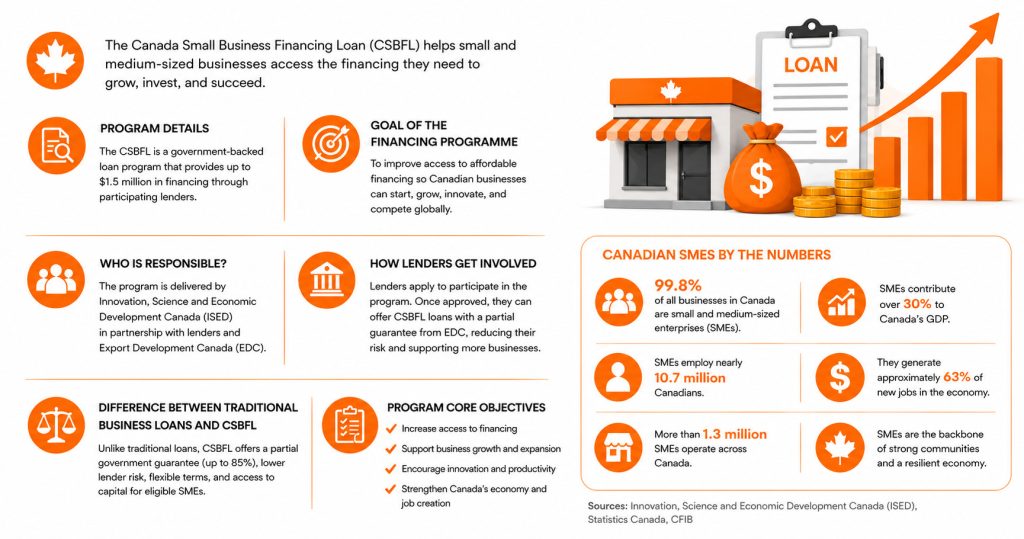
- Program details
- Goal of the financing programme
- Who is responsible
- How lenders get involved
- Difference between traditional business loans and CSBFL
- Program core objectives
2. Why Small Businesses Need Business Financing
Discuss it
- Price Rise
- Rising operating costs
- Cash flow issues
- More chances
- Instrument replacement
- Technological progress
- Upgrades to Commercial Property
3. What Can You Use a Canada Small Business Financing Loan For?
Flexibility is one of the biggest advantages of a Canada small business financing loan. Eligible businesses can use the funds to invest in assets that support long-term growth, improve productivity, and strengthen competitiveness. This type of financing may be used to assist in funding substantial capital expenditures when starting or expanding a business.
Typical eligible expenses include:
Equipment
Acquire or upgrade machinery, manufacturing equipment, office furniture, commercial vehicles, or specialized tools necessary to sustain daily operations.
Leasehold Improvements
Renovate or improve leased commercial space, including flooring, lighting, plumbing, electrical systems, and accessibility upgrades.
Commercial Real Estate
Buy or improve commercial real estate to run your business.
Business Upgrades
Renovate your facilities, enhance operational efficiency, or enlarge your workspace to accommodate business expansion.
Technology Investments
Invest in computers, software, cybersecurity, cloud solutions, automation systems, and other digital technologies to improve productivity.
Energy-Efficient Modifications
Install energy-saving equipment, upgrade heating and cooling systems, improve insulation, or invest in sustainable technologies that will reduce operating costs.
The program offers a wide range of financing options, but there are some limitations. Generally, a Canada Small Business Financing Loan cannot be used for working capital, to purchase inventory, to pay business operating expenses, to pay franchise fees, to purchase goodwill, to pay research and development costs, or to refinance existing debt. Review the program guidelines before applying to ensure your intended expenses are eligible.
4. Who Is Eligible?
Typical Cover
- Business matters
- Limits on yearly profits
- Canadian companies
- Preliminary eligibility
- Sole Ownership
- Company Cooperation
- Include common mistakes.
5. Canada Small Business Financing Loan vs Traditional Business Loan
Choosing between a Canada small business financing loan and a traditional business loan depends on your financing needs, business stage, and eligibility. While both options provide access to capital, the government-backed program is specifically designed to help eligible small businesses secure financing for long-term investments such as equipment, leasehold improvements, and commercial real estate. Traditional business loans, on the other hand, may offer broader funding options but often have stricter lending requirements.
The table below highlights the key differences between the two financing options.
| Feature | Canada Small Business Financing Loan | Traditional Business Loan |
| Eligibility | Eligible Canadian small businesses that meet program requirements | Determined by each lender’s credit and financial criteria |
| Interest Rates | Competitive rates within government program guidelines | Vary by lender, credit profile, and loan type |
| Government Support | Yes, the Government of Canada shares a portion of the lending risk | No government guarantee or risk sharing |
| Loan Amount | Based on program limits and eligible business expenses | Varies depending on the lender and business qualifications |
| Security | Security requirements follow program rules and lender policies | Often requires business assets or personal collateral |
| Flexibility | Intended for eligible capital investments such as equipment, leasehold improvements, and commercial property | Can be used for a wider range of business purposes, depending on the lender |
| Approval Process | Requires meeting both program eligibility and lender requirements | Based solely on the lender’s underwriting and approval process |
For many entrepreneurs, a Canada Small Business Financing loan offers an excellent opportunity to access affordable financing with government support, especially when investing in long-term business assets. However, businesses seeking funding for working capital or other ineligible expenses may find a traditional business loan more suitable. Comparing both options carefully can help you choose the financing solution that best aligns with your business goals and financial situation.
6. Step-by-Step Application Process
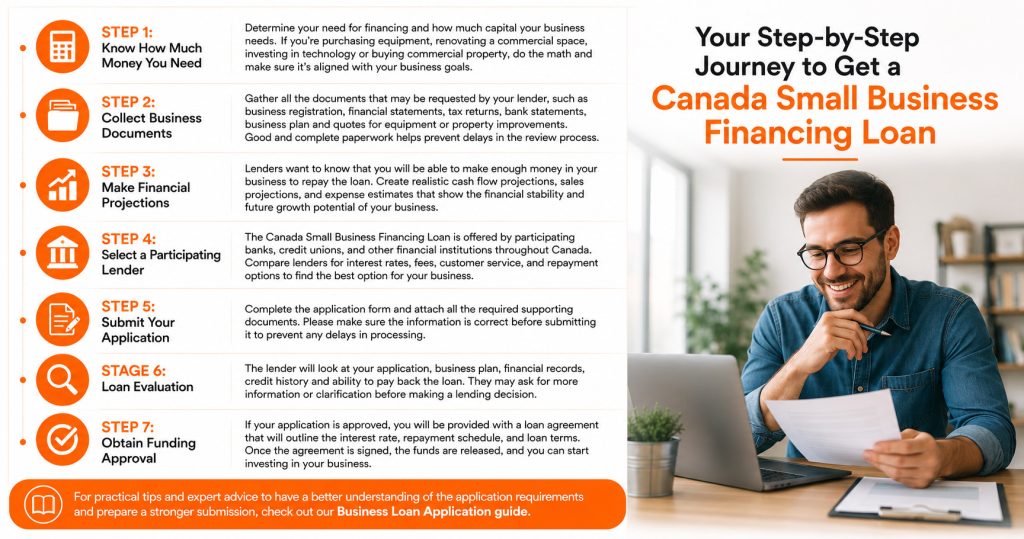
With a clear plan and the required documentation, applying for a Canada Small Business Financing loan is easier. This will speed up the application process and also increase your chances of receiving funding. Apply with confidence using these seven steps.
Step 1: Know How Much Money You Need
Determine your need for financing and how much capital your business needs. If you’re purchasing equipment, renovating a commercial space, investing in technology or buying commercial property, do the math and make sure it’s aligned with your business goals.
Step 2: Collect Business Documents
Gather all the documents that may be requested by your lender, such as business registration, financial statements, tax returns, bank statements, business plan and quotes for equipment or property improvements. Good and complete paperwork helps prevent delays in the review process.
Step 3: Make Financial Projections
Lenders want to know that you will be able to make enough money in your business to repay the loan. Create realistic cash flow projections, sales projections, and expense estimates that show the financial stability and future growth potential of your business.
Step 4: Select a Participating Lender
The Canada Small Business Financing Loan is offered by participating banks, credit unions, and other financial institutions throughout Canada. Compare lenders for interest rates, fees, customer service, and repayment options to find the best option for your business.
Step 5: Submit Your Application
Complete the application form and attach all the required supporting documents. Please make sure the information is correct before submitting it to prevent any delays in processing.
Stage 6: Loan Evaluation
The lender will look at your application, business plan, financial records, credit history and ability to pay back the loan. They may ask for more information or clarification before making a lending decision.
Step 7: Obtain Funding Approval
If your application is approved, you will be provided with a loan agreement that will outline the interest rate, repayment schedule, and loan terms. Once the agreement is signed, the funds are released, and you can start investing in your business.
For practical tips and expert advice to have a better understanding of the application requirements and prepare a stronger submission, check out our Business Loan Application guide.
7. Future of Small Business Financing in Canada
The future of Canada small business financing loan programs is being shaped by digital innovation. Digital lending platforms, AI-powered underwriting, and fintech solutions are making loan applications faster and more accessible. Government initiatives continue to support business growth, while green financing encourages sustainable investments. Alternative lending options are also expanding funding opportunities for Canadian entrepreneurs.
8. Common Reasons Why Small Business Financing Loan Applications Get Rejected In Canada
Not all Canada small business financing loan applications are approved. Lenders will review your business’s financial health and its ability to repay the loan and its overall viability before making a decision. Understanding the most common reasons for rejection can help you fortify your application and increase your chances of getting funded.
Bad Documentation
One of the most common reasons a loan will be denied is incomplete or defective paperwork. Missing financial statements, outdated business records, or an incomplete business plan can delay the review process or result in your application being declined.
Cash flow issues
Lenders will want to see that your business is making enough income to comfortably service the loan repayments. Irregular revenue or ongoing cash flow issues can lead to concerns over your ability to repay the loan.
Too Optimistic Financial Forecasts
Poor sales forecasts or unsupported revenue estimates can hurt your credibility. Financial projections should be realistic, data-driven, and consistent with your business plan.
Low Business Viability
If your business model lacks a clear market opportunity or sustainable growth strategy, lenders may consider it too risky to lend to you. You can strengthen your application by showing customer demand, competitive advantages, and long-term planning.
Existing Loan
If you owe a lot of debt, it can affect your debt-to-income ratio, limiting your ability to get more debt. Before approving new financing, lenders take a look at what you currently owe.
Lacking Information
Incompleteness of all sections of the application or failure to submit requested documents can result in considerable delay in processing or rejection of the application. Make sure that everything is correct and that all supporting documents are attached before submitting.
Tips to improve your chances of approval
Here are some best practices to increase the chances of having a Canada Small Business Financing Loan approved:
- Create a thorough and organized application.
- Maintain accurate and up-to-date financial records and statements.
- Create conservative revenue and cash flow projections.
- Before you apply, cut back on any extraneous debt you still owe.
- Create a detailed business plan with concrete growth goals.
Check your application carefully to ensure that you have not missed any information or documents.
A well-prepared application demonstrates professionalism, reduces lender concerns, and greatly increases your odds of securing the financing needed to grow your business.
9. Canada Small Business Grants vs Loans
When looking for funding opportunities, many entrepreneurs compare Canadian small business grants with business loans. Both provide financial support, but for different purposes and with different requirements. Grants usually offer non-repayable funding for certain projects, while
| Feature | Canada Small Business Grants | Canada Small Business Financing Loan |
| Funding Type | Non-repayable financial assistance | Borrowed funds that must be repaid |
| Repayment | No repayment required if program conditions are met | Regular repayments with interest according to the loan agreement |
| Eligibility | Often limited to specific industries, projects, locations, or business types | Available to eligible Canadian small businesses that meet program and lender requirements |
| Advantages | Reduces project costs, no debt, supports innovation and business development | Larger funding amounts, flexible financing for business growth, government-backed support |
| Limitations | Highly competitive, limited funding, strict eligibility requirements, lengthy application process | Interest costs, repayment obligations, lender assessment, and eligibility criteria apply |
Many successful Canadian businesses use a combination of grants and loans to finance expansion and manage costs. Please review the available funding programs before you apply to identify the solution that best matches your business objectives.
10. How to Increase Your Chances of Getting a Loan
Better preparation will increase your chances of getting a Canada Small Business Financing loan. Maintain a strong personal and business credit profile. Lenders usually check your credit history when considering approval. Manage expenses and generate steady revenue to improve your cash flow. So, create a thorough business plan with realistic financial predictions to show your ability to repay clearly. To improve your financial position, apply to pay down existing debt first. Compare multiple participating lenders to determine the best financing option for your needs. You may also want to consider professional business financing advice to submit a stronger, more competitive application.
Conclusion
The Canada Small Business Financing Loan provides eligible Canadian businesses with an affordable way to secure funding for expansion, modernization, equipment purchases, commercial property, and other long-term investments. With government-backed support, the program helps reduce financing barriers and encourages sustainable business growth. Before applying, carefully assess your funding requirements, prepare a comprehensive business plan, organize accurate financial documentation, and compare participating lenders to find the best financing solution. Taking these steps can improve your chances of approval and help your business access the capital needed to grow, innovate, and succeed in Canada’s competitive marketplace.
FAQ
1. What is the maximum Canada small business financing amount?
The maximum loan amount is subject to current program guidelines and eligible business expenses being financed. Your lender can tell you what limits apply.
2. Are startups welcome to apply?
Yes. Startups with a good business plan, realistic financial projections and a sound business model could qualify for financing.
3. Are collateral requirements in place?
“Yup. Participation lenders usually require the financed assets to be secured and may require additional collateral depending on the application.
4. How long does the approval process take?
Approval times will depend on the lender and the complexity of your application. Complete applications with all required documents are generally processed more quickly.
5. What sort of businesses are eligible?
Eligibility is open to small businesses in Canada (including sole proprietorships, partnerships and corporations) that meet program requirements.
6. Can I use a Canada Small Business Financing Loan to purchase equipment?
Yes. Eligible businesses can use a Canada Small Business Financing Loan to buy equipment, machinery, leasehold improvements, and other approved capital assets.
7. Can I pay back early?
A lot of lenders allow you to pay off early, but some may have prepayment penalties. Look over the loan agreement before you sign.
8. What is the interest rate?
Rates vary per lender and may be fixed or variable according to program guidelines.
9. Can I combine grants and loans?
Yeah. A lot of businesses also combine a Canada Small Business Financing Loan with Canadian small business grants to help fund eligible projects and lower borrowing costs.
10. How can I improve my chances of approval?
Maintain good credit, prepare a detailed business plan, provide realistic financial projections, reduce existing debt, and submit complete documentation to bolster your application.