


Most businesses cannot make enough capital from their day-to-day operations to start or grow a business. Small business loans can help you get the financial support you need to reach those goals, whether you are looking to buy equipment, expand your workspace, hire employees, or buy commercial property.
In Canada, entrepreneurs have access to a variety of financing options, such as traditional bank loans, government-backed financing programs, and a BDC loan for Canadian businesses. Understanding these options can help you pick the right financing solution and avoid costly mistakes.
This guide covers all you need to know about financing a business in Canada and practical tips to improve your chances of getting approved.
Quick Answer
Small business loans help Canadian businesses finance startup costs, equipment, inventory, expansion, working capital, and commercial property purchases. Popular options include traditional bank loans, BDC loan programs, and the Canada Small Business Financing Loan. Approval depends on your business plan, financial health, credit history, cash flow, and ability to repay the loan.
What Are Small Business Loans?
A small business loan is funds given by a bank, credit union, government program, or alternative lender to assist a business with costs that lead to growth and long-term success.
Business loans: Business loans are different from personal loans, as they are meant for business use. Often you will need to prove the ability of the business to repay the loan amount.
Finance is used by businesses to:
- Buy equipment
- Purchase inventory
- Hire employees
- Increase cash flow
- Refurbish office space
- Grow your business
- Invest in tech
- Buy commercial real estate
- Refinancing of existing debt
Why Small Businesses Need Financing
Every business reaches a stage where additional funding becomes necessary. Even profitable companies often use financing to seize growth opportunities without disrupting daily cash flow.
Common reasons include:
- Launching a new business
- Purchasing machinery
- Opening another location
- Increasing inventory
- Marketing campaigns
- Hiring staff
- Technology upgrades
- Seasonal cash flow management
- Purchasing commercial property
A manufacturing company receives a large contract but lacks sufficient equipment to fulfill the order. Instead of declining the opportunity, the company secures financing to purchase new machinery, completes the project, and increases annual revenue.
Types of Small Business Loans in Canada
Canadian businesses have access to several financing options, each designed for different business needs.
| Loan Type | Best For | Typical Repayment |
|---|---|---|
| Term Loan | Expansion projects | 1–10 years |
| BDC Loan | Business growth | Flexible |
| Canada Small Business Financing Loan | Equipment and property | Long-term |
| Line of Credit | Working capital | Revolving |
| Equipment Financing | Machinery and vehicles | Asset-based |
| Commercial Property Loans | Buying business property | Long-term |
| Invoice Financing | Improving cash flow | Short-term |
Advantages of Various Types of Loan
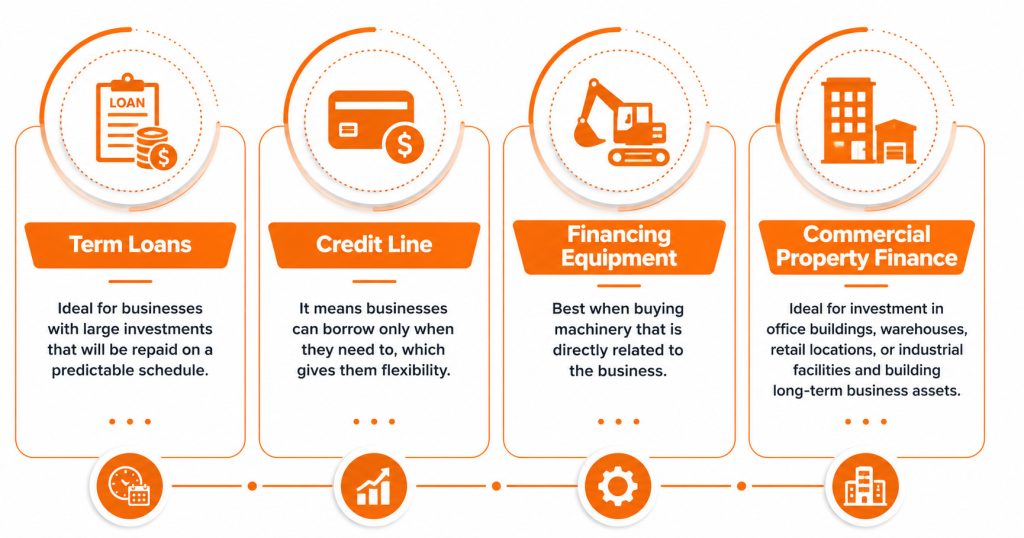
Comparison of Popular Financing Options
| Feature | BDC Loan | Traditional Bank Loan | Alternative Lender |
| Flexible Terms | ✔ | Limited | ✔ |
| Startup Friendly | ✔ | Sometimes | ✔ |
| Lower Interest Rates | ✔ | ✔ | Usually Higher |
| Faster Approval | Moderate | Slower | Fast |
| Business Advisory Support | ✔ | Rare | No |
What is a BDC loan?
A BDC loan is a loan from the Business Development Bank of Canada (BDC), which is a development bank owned by the Canadian government dedicated to helping entrepreneurs. BDC is different from many traditional lenders in that it focuses on helping businesses start, grow, innovate, and expand into new markets.
- Many businesses use a BDC loan for:
- Purchase of equipment and machinery
- Scaling Operations
- Recruitment
- Enhanced cash flow
- Technology Purchases
- Digital transformation
- Export Growth
- Purchasing a business
- Commercial real estate investment
BDC provides financing and business advisory services, making it attractive to small and medium-sized businesses that require more than just capital.
Benefits of a BDC Loan
A BDC loan is often a strong option for businesses looking for flexible financing combined with expert business guidance.
- Flexible repayment options
- Competitive interest rates
- Financing designed for Canadian businesses
- Support for startups and growing companies
- Business consulting and advisory services
- Financing for innovation and sustainability projects
A family-owned food processing company in Ontario wanted to automate part of its production line. Instead of delaying the investment, the company secured a BDC loan to purchase new equipment. The automation increased production capacity, reduced operating costs, and allowed the business to serve larger retail customers.
What Is the Canada Small Business Financing Loan?
The Canada Small Business Financing Loan is part of the Canada Small Business Financing Program (CSBFP), a federal initiative designed to make it easier for small businesses to access financing through participating financial institutions.
The program can be used for approved business investments such as the following:
- Equipment
- Machinery
- Leasehold improvements
- Commercial property
- Business renovations
The Government of Canada shares a portion of the lender’s risk, encouraging banks and credit unions to approve loans that might otherwise be difficult for smaller businesses to obtain.
Main Features
A retail business needed to renovate its storefront and purchase modern display equipment. Using a Canada Small Business Financing loan, the owner completed the renovations without significantly reducing the company’s operating cash flow.
| Feature | Canada Small Business Financing Loan |
| Government Supported | Yes |
| Available Through | Banks and Credit Unions |
| Purpose | Business assets and improvements |
| Suitable For | Small businesses |
| Collateral | May be required |
Benefits
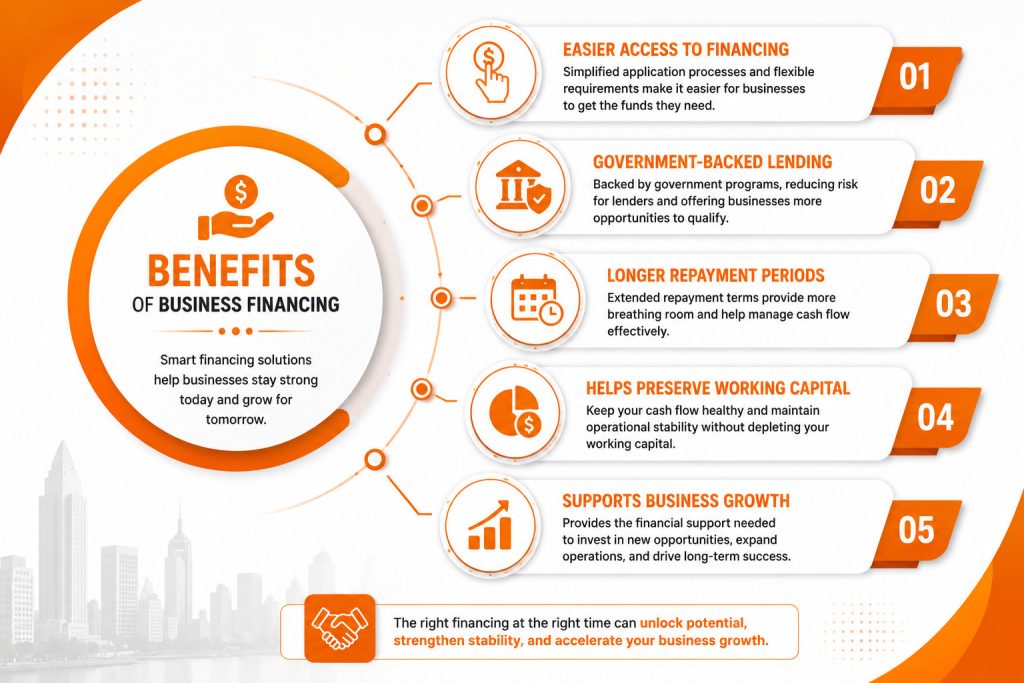
The Canada Small Business Financing Loan can help eligible businesses invest in long-term assets while benefiting from a government-supported lending program.
Commercial Property Loans
Buying commercial real estate is one of the largest investments many businesses make. Commercial property loans help finance the purchase, construction, or refinancing of business properties.
Examples include:
- Office buildings
- Retail stores
- Warehouses
- Manufacturing facilities
- Industrial buildings
- Mixed-use commercial properties
Benefits of Owning Commercial Property
- Develops long-term business ownership
- Reduces dependence on rented premises
- Offers stable operating expenses
- Creates opportunities for future expansion
- Can increase business value over time
| Buying Commercial Property | Leasing Commercial Property |
| Builds equity | No ownership |
| Long-term investment | Greater flexibility |
| Potential appreciation | Lower upfront cost |
| Fixed financing payments | Rent may increase |
A logistics company purchased a warehouse instead of continuing to lease one. Although the upfront investment was significant, ownership reduced long-term occupancy costs and provided room for future expansion.
Commercial property financing can be a strategic investment for businesses planning long-term growth.
Small Business Loan: Who Is Eligible?
The eligibility criteria vary from lender to lender, but most financial institutions consider common factors before approving financing.
- General Eligibility Criteria
- Registered Canadian company
- Clear business purpose of the loan
- Good credit history (personal and business)
- Proven ability to repay
- Robust cash flow
- Financial business statements
- Income Tax Returns
- Bank account in a commercial bank
- Licenses or permits needed
If they have a good business plan and realistic financial projections, some new businesses can qualify without a long operating history.
What Lenders Evaluate
| Factor | Why It Matters |
| Credit History | Indicates repayment reliability |
| Cash Flow | Demonstrates ability to make loan payments |
| Revenue | Measures business performance |
| Business Plan | Shows future growth strategy |
| Existing Debt | Affects repayment capacity |
| Collateral | Reduces lender risk |
Two businesses requested the same loan amount. One submitted detailed financial projections and a comprehensive business plan, while the other provided only basic information. The first application was approved more quickly because it gave the lender greater confidence in the business’s ability to repay.
How to Get a Loan for Your Business
If you’re wondering how to get a loan for your business, following a structured process can improve your chances of approval and help you choose the right financing option.
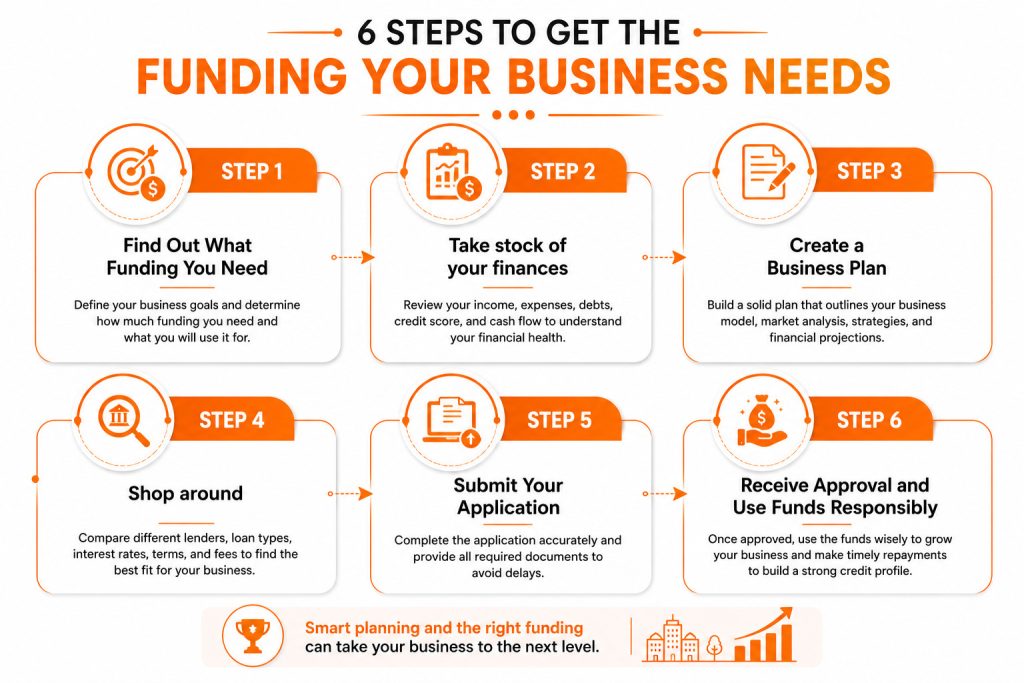
Step 1: Find Out What Funding You Need
- Figure out how much money your business needs and how the funds will be spent.
- Examples:
- Equipment purchase
- Hiring personnel
- Operations expansion
- Purchase of shares
- Buying commercial property
- Don’t borrow more than you need. The more you borrow, the bigger the repayments.
Step 2. Take stock of your finances
Evaluate the financial health of your business before applying.
Review:
- Revenue trends
- Monthly expense
- Debt outstanding
- Cashflow
- Credit report
- Make sure you have no issues that could affect your application.
Step 3: Create a Business Plan
- A good business plan will contain:
- Summary: Executive
- About the company
- Market analysis
- Marketing schemes
- Eighth, economic outlooks
- Purpose of loan
- Repayment schedule
A sound plan demonstrates that your financing request is driven by practical business goals.
Step 4: Shop around
- Consider multiple financing providers, including:
- Old school banks
- Credit unions
- BDC Canada
- Other lenders
- Contrast:
- Rate of Interest
- Terms of Repayment Fees
- Approval times
- Back up.
Step 5: Submit Your Application
Complete the application accurately and provide all required documentation. Missing or incomplete information can delay the review process.
Step 6: Receive Approval and Use Funds Responsibly
Once approved, use the financing only for the intended business purpose and monitor repayments carefully to maintain a strong credit profile for future borrowing.
Application Process Diagram
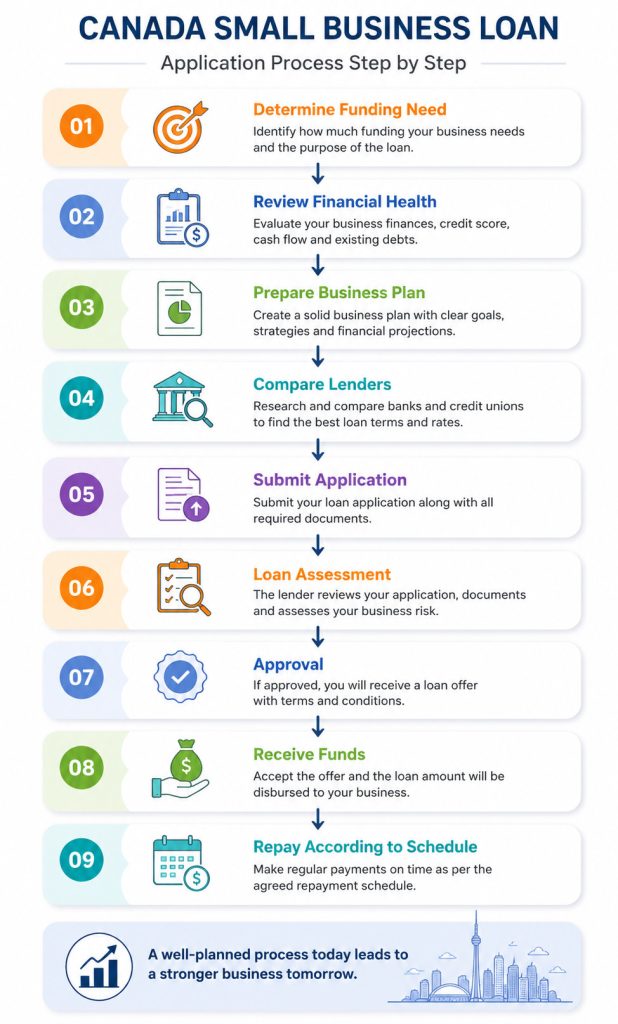
A complete application supported by accurate financial information, a realistic business plan, and clear repayment capacity significantly increases the likelihood of loan approval.
Documents You Will Generally Need
If this is your first time applying, you will need to prepare the following documents:
- Business registration or incorporation documents
- Government-issued identification
- Plan de negocios:
- Balance Sheet; tax returns;
- Business banking account statement
- Cash flow projection
- List of Existing Business Debts
- Quotes for equipment or property (if applicable)
- Lease or Purchase Agreement for Commercial Real Estate
Having these documents ready ahead of time can help to reduce processing times and demonstrate professionalism to potential lenders.
Understanding the Cost of Small Business Loans
The total cost of a small business loan isn’t just the interest rate. Before you accept financing, review all the costs associated with it so you can accurately estimate the total amount your business will repay over the life of the loan.
Typical borrowing costs are
- Interest expense
- Loan application fee
- Administrative fees
- Charges for the appraisal/valuation of commercial property
- Documentation and Legal Fees
- Late payment penalties
- Early redemption charges (if any)
Comparing the Annual Percentage Rate (APR) and the total borrowing cost—not just the advertised interest rate—provides a clearer picture of the loan’s affordability.
The lowest interest rate does not always result in the lowest overall borrowing cost. Always review the complete loan agreement before signing.
Factors That Affect Business Loan Interest Rates
Every lender uses its own underwriting criteria, but the following factors commonly influence the interest rate offered:
- Personal and business credit history
- Annual business revenue
- Cash flow consistency
- Time in business
- Industry risk
- Loan amount
- Repayment period
- Collateral provided
- Existing business debt
Businesses with strong financial records and consistent cash flow often qualify for more competitive financing terms.
Improving your business finances before applying can lead to better financing terms and lower borrowing costs.
Comparing Popular Small Business Financing Options
Choosing the right financing solution depends on your business goals, funding needs, and repayment capacity. The following comparison highlights the strengths of three common options.
| Feature | BDC Loan | Canada Small Business Financing Loan | Traditional Bank Loan |
| Government Support | Yes | Yes | No |
| Startup Friendly | Good | Moderate | Limited |
| Equipment Financing | ✔ | ✔ | ✔ |
| Commercial Property Financing | ✔ | ✔ | ✔ |
| Working Capital | ✔ | Limited | ✔ |
| Flexible Repayment | High | Moderate | Varies |
| Advisory Services | ✔ | No | Rare |
| Available Through | BDC | Participating Lenders | Banks & Credit Unions |
Which Option May Suit Your Business?
| Business Need | Recommended Financing |
| Startup funding | BDC Loan |
| Equipment purchase | Canada Small Business Financing Loan |
| Buying commercial property | Commercial Property Loan |
| Working capital | Business Line of Credit |
| Business expansion | BDC Loan or Bank Loan |
The best financing option depends on your objectives rather than a single feature such as interest rate or repayment period.
Information Gain: Practical Tips Most Business Owners Overlook
Many articles explain loan requirements but overlook the habits that improve long-term borrowing success. Based on common lender expectations and industry practices, the following strategies can strengthen both your application and your business.
1. Apply Before You Urgently Need Funding
Businesses often seek financing only when cash flow becomes tight. Applying while your financial position is stable gives lenders greater confidence and provides more financing options.
2. Separate Business and Personal Finances
Maintain dedicated business bank accounts and accounting records. Mixing personal and business transactions makes it harder for lenders to evaluate financial performance.
3. Keep Financial Statements Current
Updated financial statements demonstrate that your business is well managed and allow lenders to assess your financial position quickly.
4. Borrow for Growth, Not Routine Losses
Using financing to invest in revenue-generating assets—such as equipment, technology, or commercial property—is generally viewed more favourably than borrowing to cover recurring operating losses.
5. Build Relationships With Lenders
Even if you do not need financing today, establishing a relationship with your bank or financial advisor can make future applications smoother.
Preparation before applying often has a greater impact on approval than the application itself.
Common Mistakes to Avoid
Avoiding these common errors can improve your chances of approval and help protect your business’s financial health.
Applying Without a Clear Purpose
Lenders want to understand how the funds will support business growth. Clearly define the intended use of the loan.
Borrowing More Than Necessary
Higher loan amounts increase repayment obligations and may strain cash flow.
Ignoring Cash Flow
Revenue alone does not guarantee loan affordability. Evaluate whether your business can comfortably manage monthly repayments.
Submitting Incomplete Documents
Missing financial statements, tax returns, or business plans can delay approval or result in rejection.
Applying to Multiple Lenders Simultaneously
Submitting numerous applications within a short period may negatively affect your credit profile and create unnecessary complexity.
External References
- Government of Canada – Canada Small Business Financing Program
Learn about eligibility, loan limits, participating lenders, and program features.
Canada Small Business Financing Program - Innovation, Science and Economic Development Canada (ISED) – Helping Small Businesses Get Loans
Official overview of the Canada Small Business Financing Program, including eligible businesses and financing limits.
Helping Small Businesses Get Loans - Business Development Bank of Canada (BDC)
Explore financing solutions, business loans, advisory services, and growth resources for Canadian entrepreneurs.
Business Development Bank of Canada (BDC) - Statistics Canada
Official Canadian statistics on businesses, employment, economic performance, and industry data.
Statistics Canada - Innovation, Science and Economic Development Canada – SME Research and Statistics
Access the latest reports on Canadian small and medium-sized businesses, financing trends, credit conditions, and economic contributions.
SME Research and Statistics - Canada Small Business Financing Program Documentation Centre
Official program guides, regulations, lender resources, evaluation reports, and historical statistics.
CSBFP Documentation Centre - Canada Small Business Financing Program – Overview and Highlights 2024–25
Annual report summarizing program performance, borrower trends, loan activity, and financing outcomes.
CSBFP Overview and Highlights 2024–25 - Innovation, Science and Economic Development Canada – Evaluation of the Canada Small Business Financing Program
Independent evaluation of the program’s effectiveness, impact, and recommendations.
Evaluation of the Canada Small Business Financing Program
These references come from official Canadian government and institutional sources and are appropriate for supporting a publication-quality article on small business loans, BDC loans, and the Canada Small Business Financing Program.
Bottom Line
Choosing the right small business loans can provide the capital your business needs to start, expand, or improve operations without putting unnecessary strain on cash flow. Whether you’re considering a BDC loan, applying for a Canada Small Business Financing Loan, or exploring commercial property loans, the best financing option depends on your business goals, financial health, and long-term growth strategy.
FAQ
1. What are small business loans in Canada?
Small business loans are financing solutions that help Canadian businesses cover expenses such as equipment purchases, inventory, working capital, commercial property, and business expansion. They are available through banks, credit unions, the Business Development Bank of Canada (BDC), and government-backed programs like the Canada Small Business Financing Program.
2. How do I get a loan for my business in Canada?
To get a business loan, determine how much funding you need, prepare a detailed business plan, gather financial statements and tax returns, compare lenders, and submit a complete application. Lenders typically assess your credit history, cash flow, revenue, and ability to repay before approving financing.
3. What is a BDC loan, and who can apply?
A BDC loan is financing provided by the Business Development Bank of Canada to support entrepreneurs at various stages of business growth. Eligible applicants generally include Canadian startups, small businesses, and established companies seeking funding for expansion, equipment, technology, or commercial real estate investments.
4. What is the Canada Small Business Financing Loan?
The Canada Small Business Financing Loan is offered through the Canada Small Business Financing Program (CSBFP), which helps small businesses obtain financing from participating financial institutions. Eligible businesses can use the funds to purchase equipment, leasehold improvements, or commercial property while benefiting from government-backed risk sharing.
5. Can I use a small business loan to buy commercial property?
Yes. Many lenders offer commercial property loans that allow businesses to purchase office buildings, retail stores, warehouses, industrial facilities, or other commercial real estate. Some eligible property purchases may also qualify under the Canada Small Business Financing Program, depending on program requirements.
6. What documents do I need to apply for a business loan?
Most lenders require business registration documents, financial statements, tax returns, bank statements, a business plan, cash flow projections, and identification. Depending on the loan purpose, you may also need equipment quotes, property purchase agreements, or additional supporting documents.
7. How long does it take to get approved for a small business loan?
Approval times vary depending on the lender and the complexity of the application. Some online lenders may provide decisions within a few days, while banks and government-supported financing programs can take several weeks due to additional documentation and underwriting requirements.
8. What factors affect business loan approval?
Lenders evaluate several factors, including your credit history, business revenue, cash flow, time in business, existing debt, collateral, and the strength of your business plan. Demonstrating stable financial performance and a clear repayment strategy can improve your chances of approval.
9. What is the difference between a BDC loan and a traditional bank loan?
A BDC loan is specifically designed to support Canadian entrepreneurs and often includes flexible repayment options and business advisory services. Traditional bank loans may offer competitive rates but typically have stricter lending criteria and may require a longer operating history or stronger collateral.
10. How can I improve my chances of getting a small business loan?
Improve your chances by maintaining a good credit history, preparing accurate financial statements, creating a detailed business plan, reducing unnecessary debt, demonstrating consistent cash flow, and borrowing only the amount your business genuinely needs. Comparing multiple lenders can also help you find financing that matches your business goals.